
Industry · Ecommerce
ChatGPT Ads for ecommerce and Shopify stores
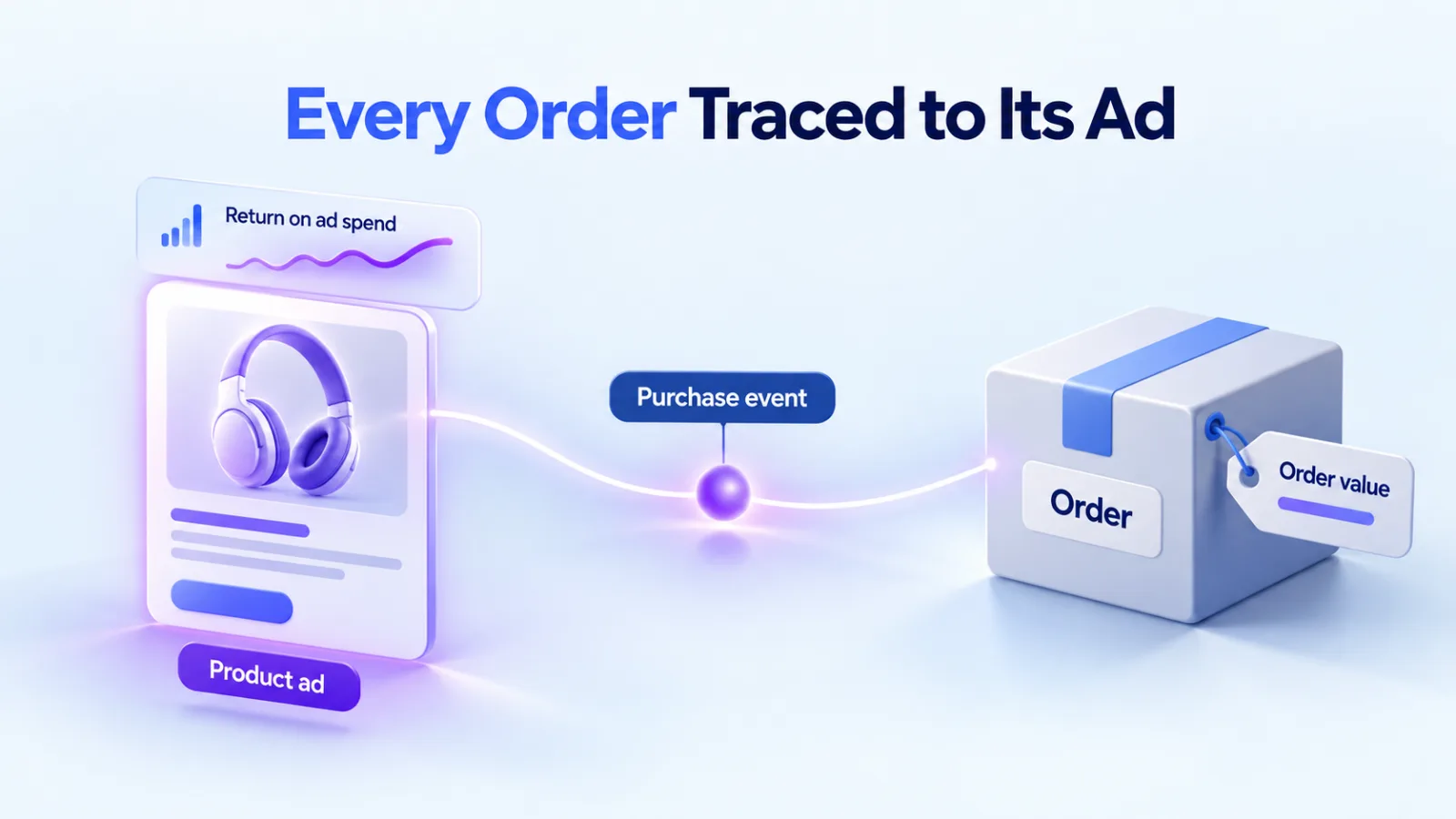
People ask ChatGPT to help them choose what to buy. Product ads put items from your catalog below those answers, filled in from your product feed, and purchase tracking ties each sale back to the ad.
At a glance
| Policy | Consumer goods are in scope |
| Formats | Product ads from a feed, and chat cards |
| Shopify | An app for US merchants |
| Tracking | Orders with their value |
Fit
Where online stores stand
- Consumer goods are in scope. OpenAI’s ad policy names household and consumer goods among the categories ads focus on while the program is young.
- Your catalog can become the ads. Product-feed campaigns fill each ad with a product’s title, description, price, image and link.
- Sales are measurable. Purchase events with order value give you attributed sales and return on ad spend in Ads Manager.
- Shopify has an app. It syncs your catalog and purchase events. It’s open to US merchants now, and OpenAI says it will reach every ChatGPT Ads market shortly.
Sources: Ad policies; Product feeds, developer docs; Set up ChatGPT Ads for Shopify, Help Center. Checked 27 September 2026.
Policy
Is your product category allowed?
Most store categories are fine. These are the ones OpenAI’s policy singles out.
| Category | Where it stands | Source |
|---|---|---|
| Household and consumer goods | In scope: one of the categories the policy says ads focus on in the early phases. | Ad policies |
| Lingerie and swimwear | May be allowed when shown in a standard fashion or retail context, not framed to arouse. | Ad policies |
| Fitness and wellness | Fitness equipment, wearables and other wellness products may be allowed if they make no medical claims. | Ad policies |
| Dietary supplements | US only, for approved advertisers, case by case. Supplements marketed with unsupported health claims aren’t allowed. | Ad policies |
| CBD and hemp | Non-intoxicating products, such as CBD topicals with no THC and hemp clothing, may be allowed. THC products aren’t. | Ad policies |
| Alcohol, tobacco and vapes | Not allowed, including drinks over 0.5% ABV, cigarettes, vaping and nicotine products. | Ad policies |
| Adult products | Not allowed, including sexual health products. | Ad policies |
| Weapons | Not allowed. A business built mainly around restricted or prohibited products may not be able to advertise at all. | Ad policies |
| Replicas | Counterfeits and knockoffs of other brands aren’t allowed. | Ad policies |
Formats
Three ways to put products in ChatGPT
Catalog
Product ads from a feed
A product-feed campaign turns catalog rows into ads. Each ad takes its title, description, price, image and link from the product, and filters decide which products an ad group can use: brand, category, price or your own labels.
Single ad
One ad for a range or an offer
A standard ad shows your name and icon, a title of up to 50 characters, up to 100 characters of copy and an image. It links to a page you choose, such as a collection or a sale.
Shopify · US
Campaigns from inside Shopify
The ChatGPT Ads app lets you launch a campaign for all products, a single product or your website without leaving Shopify. Budgets there move in $25 steps; Ads Manager allows amounts in between.
Sources: Product feeds and Ads API reference, developer docs; Set up ChatGPT Ads for Shopify, Help Center.
Paid vs organic
Shopping results aren’t ads
When someone shops in ChatGPT, it can show product results with images, prices and links. OpenAI says those results are chosen independently and aren’t ads, so there’s no paying your way into them.
What feeds them is product data. Shopify stores’ products already reach ChatGPT through Shopify Catalog, with no extra work. Other merchants can apply to send OpenAI a product feed directly. When several merchants sell the same item, ChatGPT ranks them on factors such as availability, price, quality and whether the merchant makes or mainly sells it.
Our guide to getting products into ChatGPT shopping covers the free route in detail. Product ads sit apart from all that: a paid, labeled placement below the answer. Our shopping ads service covers how one feed can serve both.
Source: Shopping with ChatGPT search, OpenAI Help Center, checked 27 September 2026.
Setup
What a store needs before launch
Step 1 · Check
Category and countries
Check your products against the policy, and your business against the countries where self-serve is open. Product-feed campaigns target by country.
Step 2 · Catalog
Get your products in
Connect the Shopify app, or upload a CSV feed over SFTP and update prices and stock through the Delta API. Product pages and images need public HTTPS links.
Step 3 · Tracking
Track every order
Send order_created events with the order value from the pixel and the Conversions API, using shared event IDs so no order counts twice.
Step 4 · Access
Let OpenAI’s crawlers in
Product pages must not block OAI-AdsBot or OAI-SearchBot. Check robots.txt and any bot protection on your store.
Step 5 · Structure
Group products by margin
Split the catalog into ad groups with product filters and custom labels, so each group’s bid matches what its sales are worth.
Context hints
Describe the shopping moment, not the product name
Context hints are set per ad group. OpenAI describes them as a way to cover the products, uses or needs your page and ad don’t fully explain, and they aren’t exact-match keywords. For a store, that means describing who is shopping and why.
| Store | Keyword-style (weak) | Shopping moment (stronger) |
|---|---|---|
| Trail shoes | trail shoes, running shoes, best shoes | Runners training for a first trail race who want grip and cushioning on rocky ground |
| Furniture | sofa, couch, sectional | People furnishing a small apartment who need a sofa that fits through narrow doors |
| Gifts | gifts, presents, gift ideas | Shoppers choosing a practical gift for friends who just had a baby |
Measurement
Tracing sales back to ads
| Topic | How it works | Source |
|---|---|---|
| Sales | Attributed sales and return on ad spend in Ads Manager come from order_created purchase events. | Developer docs |
| Duplicates | Send the same event name and event ID from the pixel and the Conversions API, and OpenAI counts the order once. | Developer docs |
| Windows | Click-through windows of 7, 14 or 30 days; view-through off or 1 day. | Developer docs |
| Timing | Clicks and impressions refresh about every 15 minutes and spend can lag 7–8 hours. Allow 24–48 hours for attributed conversions. | Help Center |
| Products | Product-level reporting shows which products got impressions and clicks. | Developer docs |
| Shopify | Results show in Shopify’s Analytics tab, with the detail in Ads Manager. | Help Center |
| UTMs | Tracking parameters can be added to product links through the campaign’s landing page settings. | Developer docs |
OpenAI’s own example is one unnamed ecommerce advertiser that reached a 3x return on ad spend across its campaigns over 28 days. One advertiser isn’t a benchmark: the return you need depends on your margins, and the cost calculator shows your break-even point.
Source: A milestone in expanding access to AI, OpenAI, 31 August 2026.
Questions
Ecommerce questions
Do we need Shopify?
No. Any store can send a product feed as a CSV file over SFTP. The Shopify app makes setup quicker; it’s open to US merchants for now.
Can we advertise outside the US?
Yes, if your business is based in one of the 63 countries on OpenAI’s self-serve list. Product-feed campaigns choose which countries to target. See the availability tracker.
What does it cost?
Ads are sold at auction and billed per click or per 1,000 impressions, never per sale. In the US the minimum is $25 a day per campaign. Our fees are on the pricing page, and the calculator estimates clicks, sales and return from your numbers.
Will ads get our products into ChatGPT’s shopping results?
No. OpenAI says product results are chosen independently and aren’t ads.
What happens when a product sells out?
Mark it out of stock in your feed or through the Delta API. Once the change goes through, the product stops qualifying for ads.
Can we advertise supplements or CBD?
Sometimes. Supplements are considered case by case, in the US only. Non-intoxicating CBD products may be allowed, and THC products aren’t. The policy table above has the detail.
Related
Ongoing
Shopping and product feed ads
We build and run the feed, the Shopify setup and your product campaigns.