
Service · one-time or ongoing
Context hints and ad creative
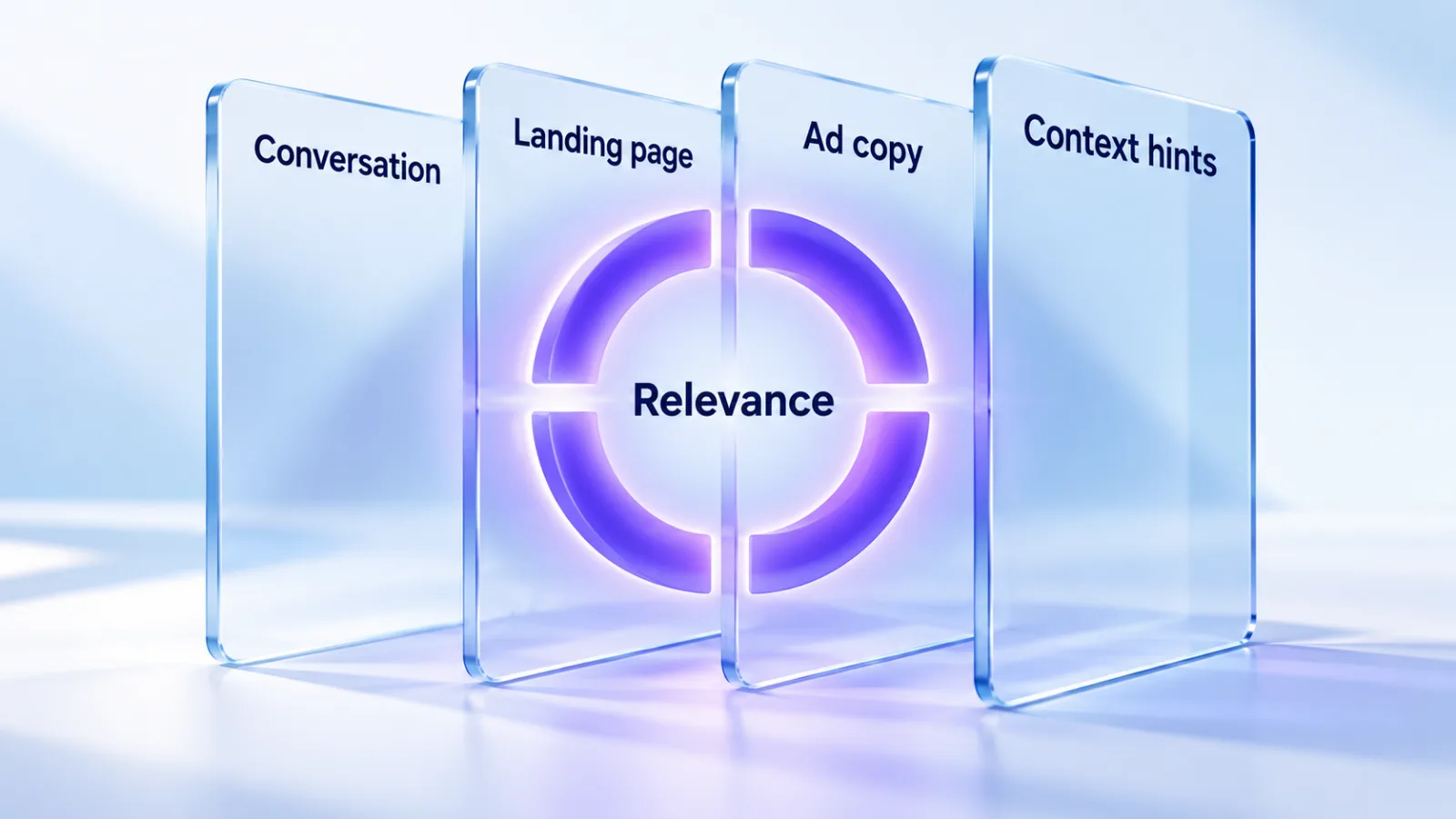
ChatGPT doesn’t run ads against keyword lists. It weighs the conversation, your landing page, your ad and your context hints. We write the hints and the ads so all four describe the same customer.
At a glance
| Format | One-time, or ongoing with management |
| Covers | Context hints and ad copy |
| Limits | 50-character titles, 100-character copy |
| Goal | Hint, page and ad describe one customer |
Included
What you get
- Customer research: the questions, situations and objections that come before a purchase
- Context hints for each ad group, each written around one specific situation
- Several distinct ad variations per offer, within OpenAI’s character limits
- Images chosen to match the message
- Landing page checks for message match and crawler access
- Monthly refreshes as results come in, when combined with management
How matching works
How ChatGPT picks an ad
According to OpenAI, ad selection weighs the context of the conversation, the ad’s landing page, title and copy, the context hints you provide and, when a person has ads personalization on, signals from their wider ChatGPT use.
That means your landing page and ad copy shape where the ad shows up, not just whether people click. Hints fill in what the page and ad don’t say. They guide matching, but they aren’t exact-match keywords and they don’t guarantee delivery. When several ads are eligible, relevance and bids decide which one shows first.
Sources: Ads in ChatGPT, The Basics, OpenAI Help Center.
Context hints
Hints that describe a situation
OpenAI’s own guidance, in short, and how we apply it. Our ad creative guide has worked examples.
Source: Write context hints, OpenAI Help Center.
- One idea per hint. A clear, natural phrase rather than a list of disconnected keywords.
- What, who and when. Cover features, pricing or service areas; the customer it suits; and the situations where it helps.
- Add what isn’t obvious. Hints should say something the ad and landing page don’t already make clear, or connect a feature to a need.
- Keep them accurate. Update hints when features, pricing, availability or service areas change.
- Don’t use them as rules. Hints can’t enforce locations, schedules or exclusions. Use targeting settings for that.
- Group them by need. Keep hints for one product or customer need together, and split ad groups when the message or landing page differs.
| Business | Keyword-style (weak) | Situation (stronger) |
|---|---|---|
| Agency CRM | crm, agency crm, best crm | Client and project CRM for agencies of 5 to 50 people that bill on retainer |
| Plumber | plumber chicago, emergency plumber | Same-day emergency plumbing for homes in Chicago, including nights and weekends |
| Running shoes | running shoes, cheap trainers | Wide-fit running shoes for beginners training for their first 10K |
The ad
The ad card, by the numbers
| Element | What OpenAI specifies | Source |
|---|---|---|
| Title | 3 to 50 characters. | Developer docs |
| Body | Up to 100 characters. | Developer docs |
| Name and icon | Every ad shows the advertiser’s name and icon, alongside the ad’s image. | Help Center |
| Landing page | Must be a valid, reachable page that doesn’t block OAI-AdsBot or OAI-SearchBot. | Help Center |
| Tracking | You can add your own UTM parameters to each ad’s destination URL. | Help Center |
Questions
About hints and creative
How many context hints should an ad group have?
Enough to cover the distinct situations where your offer genuinely helps, each focused on one idea. OpenAI’s guidance favors specific, accurate hints over long keyword-style lists, so more isn’t automatically better.
Will our ads show in every relevant conversation?
No. Hints inform relevance but don’t guarantee delivery, and when several ads are eligible, relevance and bids decide which one shows first.
Does Ads Manager write ads for us?
It can prefill a draft from your website’s metadata, with an image, title and description, for you to review and edit. OpenAI says this uses existing metadata and doesn’t generate new copy or images with AI.
Why does the landing page matter so much?
OpenAI uses it as a relevance signal when choosing ads, and the ad, image and page all have to meet the ad policy together. A page that says something different from the ad can be rejected as inconsistent.
Related services