
A ChatGPT ad appears right after someone has explained what they need. A slogan has a harder job there than a plain statement of what you offer. OpenAI’s own guidance says ads with clear, specific, benefit-focused copy are more likely to be relevant. This guide shows how to write titles, copy and images that follow it. They stay inside the policy and give the system enough variety to work with.
The example ads are ours, written for illustration. Each line would have to be true for the business running it.
In brief
- Write for the person’s situation and drop the slogan.
- Titles say what the product is. Copy adds what the title didn’t.
- Write several variations per offer, each with a different angle.
- Match the image, the landing page and the claims to the words.
- Judge creative on clicks first, and on conversions once they arrive.
What a chat card is made of
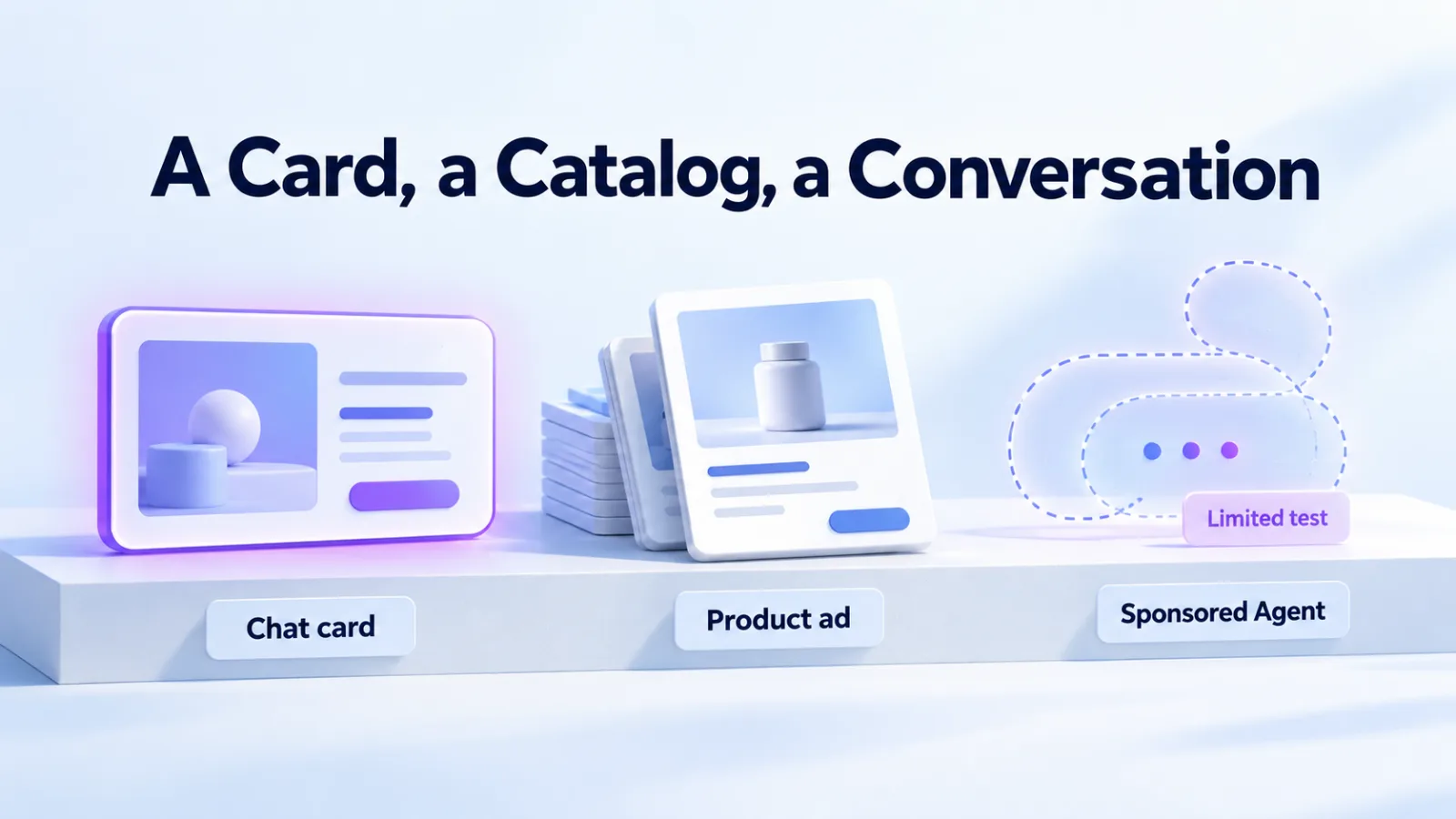
A chat card has a small number of parts, each with its own limit.
| Part | Spec |
|---|---|
| Name and icon | Your account’s name and icon, the same on every ad. |
| Title | Up to 50 characters. OpenAI recommends 16 to 24. |
| Copy | Up to 100 characters. OpenAI recommends 32 to 48. |
| Image | Square PNG or JPG, no larger than 1,200 by 1,200 pixels. |
| Price | Optional. |
| Landing page | Must load and let OpenAI’s crawlers in. UTM parameters are allowed. |
Full specs for every format are in our guide to ChatGPT ad formats.
OpenAI’s five rules of thumb
OpenAI’s creative guide starts from the difference with keyword platforms. ChatGPT weighs several relevance signals, including what the person is trying to do. Its guidance comes down to five rules.
| Rule | What it means | How we’d apply it |
|---|---|---|
| Build for coverage | Many title and copy variations per offer give the system more chances to find a moment where your ad fits. | Write one variation per reason someone might choose you. |
| Keep variations distinct | Each one should bring a different angle, not the same message reworded. | Change the reason someone would choose you. |
| Be useful | The ad should feel helpful for what the person is doing. | Answer the question they’d ask next. |
| Be accurate | OpenAI says honest messaging improves both the experience and performance. | Only describe features and offers you really have. |
| Follow the policy | The copy, image and landing page must all comply. Misleading or inconsistent ads get rejected. | Check all three before you submit. |
ChatGPT ad creative starts with the title: say what it is
OpenAI asks for titles that spell out the value, stay concise and put useful detail ahead of broad marketing language. The weaker titles below say nothing specific. Words like “best” and “number one” are claims you would have to prove.
| Business | Weaker title | Stronger title |
|---|---|---|
| Trail shoe shop | Amazing Shoes! Shop Now (23) | Grippy shoes for trails (23) |
| Accounting app | The #1 Accounting Solution (26) | Freelance bookkeeping (21) |
| House cleaning | Best Cleaners In Town (21) | Move-out deep cleaning (22) |
Numbers in brackets are character counts. They’re illustrative.
Copy: add what the title didn’t say
OpenAI’s guidance for copy is to complement the title instead of repeating it. Expand on the benefits, features or uses, and keep the language easy to scan. Pair each title with copy that answers the next question the person would ask.
| Title | Weaker copy | Stronger copy |
|---|---|---|
| Grippy shoes for trails | Shoes for every runner, every day, everywhere! (46) | Deep lugs and a rock plate for technical trails. (48) |
| Freelance bookkeeping | Quality you can trust. Click to learn more. (43) | Tag receipts as you go and export for tax time. (47) |
| Move-out deep cleaning | Book the best cleaners today! (29) | Deep cleans for renters handing back the keys. (46) |
The weak copy has the same fault in each example. It repeats the mood of the title and adds no fact. The stronger copy adds one concrete detail the title left out.
A worked example for software
Software is harder to write for than shoes, because the product is abstract. Take the fictional Fieldnote CRM, used in our ad preview tool. Its buyers are small agencies, and each buyer has a different reason to care. One variation per reason gives the system five different moments to match.
| Angle | Title | Copy |
|---|---|---|
| The product | CRM built for agencies (22) | Pipelines, proposals and invoicing in one place. (48) |
| Billing | Invoice retainers faster (24) | Bill from the same record you track work in. (44) |
| Clients | One live client view (20) | Share progress without exporting a report. (42) |
| Sales | Track deals to proposal (23) | Follow every deal from first call to proposal. (46) |
| Planning | Plan the week by client (23) | See every client’s tasks and deadlines at once. (47) |
Each variation names a different job. None of them claims a result, and none promises speed or savings that the product might not deliver. That restraint keeps them within the policy.
Write variations with different angles
We think the easiest way to follow OpenAI’s “distinct angles” advice is to write one variation per reason someone might choose you. For the trail shoe shop, that could be the product, the occasion, the fit and the offer.

| Angle | Title | Copy |
|---|---|---|
| The product | Grippy shoes for trails | Deep lugs and a rock plate for technical trails. |
| The occasion | Light shoes for race day | Cushioned trail shoes for your first ultra. |
| The fit | Wide-fit trail runners | Roomy toe boxes in every size, half sizes too. |
| The offer | Free returns on any shoe | Try them on a real run. Send back if they rub. |
Give each ad group its own set, matched to its context hints. The hints describe the situation, and the ads answer it.
A process for the first draft
A short routine beats a blank page. Work through it once per offer.
- List the reasons someone would choose you. Aim for four or five, in the customer’s words.
- Write a title for each, in everyday words, within the recommended range.
- Write copy that adds one fact the title left out.
- Choose one image that fits the title, and check it is square and within the size limit.
- Pick the landing page that continues the same story, and tag its URL.
- Check each ad against the policy table below, then submit.
The routine keeps variations apart. A reason that appears twice is a candidate for deletion.
Images and landing pages
OpenAI asks for simple, relevant visuals that match the title and copy, and warns against abstract or cluttered ones. A clear product shot, or a picture of the result, usually does it.
Link to the most relevant page, such as a product, collection or content page, rather than your homepage. Then the path from ad to action is obvious. Add UTM parameters to each destination URL, as our guide to ChatGPT ad clicks in GA4 explains.
The page must also load and let OpenAI’s crawlers in. OpenAI says OAI-AdsBot is the one it requires for ads review, and that blocked landing pages are a common cause of rejection.
What gets creative rejected
OpenAI’s baseline standards apply to every ad, whatever the category.
| Rule | What it rules out |
|---|---|
| Truthfulness | Unfounded claims about capabilities, pricing, outcomes, affiliations or comparisons. Exaggerated results and false endorsements. |
| Language | Obscene, vulgar or shocking wording, including in product names and branding. |
| Discrimination | Derogatory, defamatory or exclusionary content aimed at people or groups. |
| Interface imitation | Ads that copy the look, function or voice of ChatGPT, so people might think the ad is part of the answer. |
| Consistency | An allowed ad linking to a page that promotes something disallowed. |
| Brand use | Trademarks and logos you don’t own or aren’t authorized to use, and implied endorsements. |
OpenAI says every edit to ad creative creates a new version that goes through review again. So batch your changes, instead of tweaking one word at a time.
Three creative mistakes that cost clicks
Most weak ads fail in one of three ways.
Writing for the headline, not the situation
A title that sounds clever but names nothing specific gives the system nothing to match. Say what the product is.
Stacking claims
“Fastest, cheapest and best” is three unproven claims. OpenAI’s policy bans unfounded claims about pricing and outcomes. One true, specific line beats three vague ones.
Mismatched image and words
An image of a lifestyle scene beside a title about a technical feature confuses the reader. OpenAI asks for visuals that fit the message.
OpenAI’s AI creative tools
OpenAI’s tools for drafting ads make suggestions. You decide what runs.
| Tool | What it does |
|---|---|
| Suggested copy and images | When you draft an ad, Ads Manager can suggest copy and imagery from your landing page and objective. Nothing is used until you review, edit and add it. |
| Suggested drafts | An “Add new ad” option can prefill a draft from your website’s metadata. OpenAI says it doesn’t generate new copy or images with AI. |
| Text customization | An opt-in setting that adapts your headlines and descriptions to the conversation and translates them into the person’s preferred language. |
We’d turn text customization on only if your brand rules allow copy you haven’t approved word for word.
Testing creative
Our view: judge creative first on click-through rate, since clicks arrive within minutes while conversions take a day or two. Replace the weakest ads with new angles every couple of weeks, instead of rewriting everything. Keep enough variations live that the system still has choice.
Our 30-day test plan puts this on a schedule. If ads aren’t running at all, check why ads aren’t showing before you rewrite anything.
Questions
How many ads should each ad group have?
OpenAI doesn’t give a number. It recommends a high volume of distinct variations per offer. We’d start with one per angle, typically three to five, and add more as you learn what works. Keep each ad group’s ads tied to one theme, so the hints and the copy tell the same story.
Should titles include a call to action?
OpenAI’s guidance favors practical value over a catchy line or generic call to action. Use the space to say what you offer and who it’s for. If the ad is clear about the value, the click already is the action.
Can I mention a competitor?
Carefully. The policy bans unfounded comparisons with other products or companies. It also bans using marks you aren’t authorized to use. A claim you can’t prove about a named rival is exactly what it rules out, so keep any comparison factual and checkable.
Can ChatGPT write my ads?
Ads Manager can suggest copy and images from your landing page, and you can opt in to text customization. Either way, you’re responsible for what the ad claims. Review every suggestion before it runs, and edit anything that isn’t true.
Does the image matter more than the words?
OpenAI gives guidance on both and doesn’t rank them. It asks for simple, relevant images that match the message. A mismatch between the two weakens the ad. Get the words right first, then choose an image that fits them.
How often should I change my ads?
Not constantly. Each edit sends the ad back through review, and OpenAI advises against changing several settings at once. Replace the weakest ads every couple of weeks, and give each change a full week of data.
Want ads and hints written for you? See our context hints and creative service.