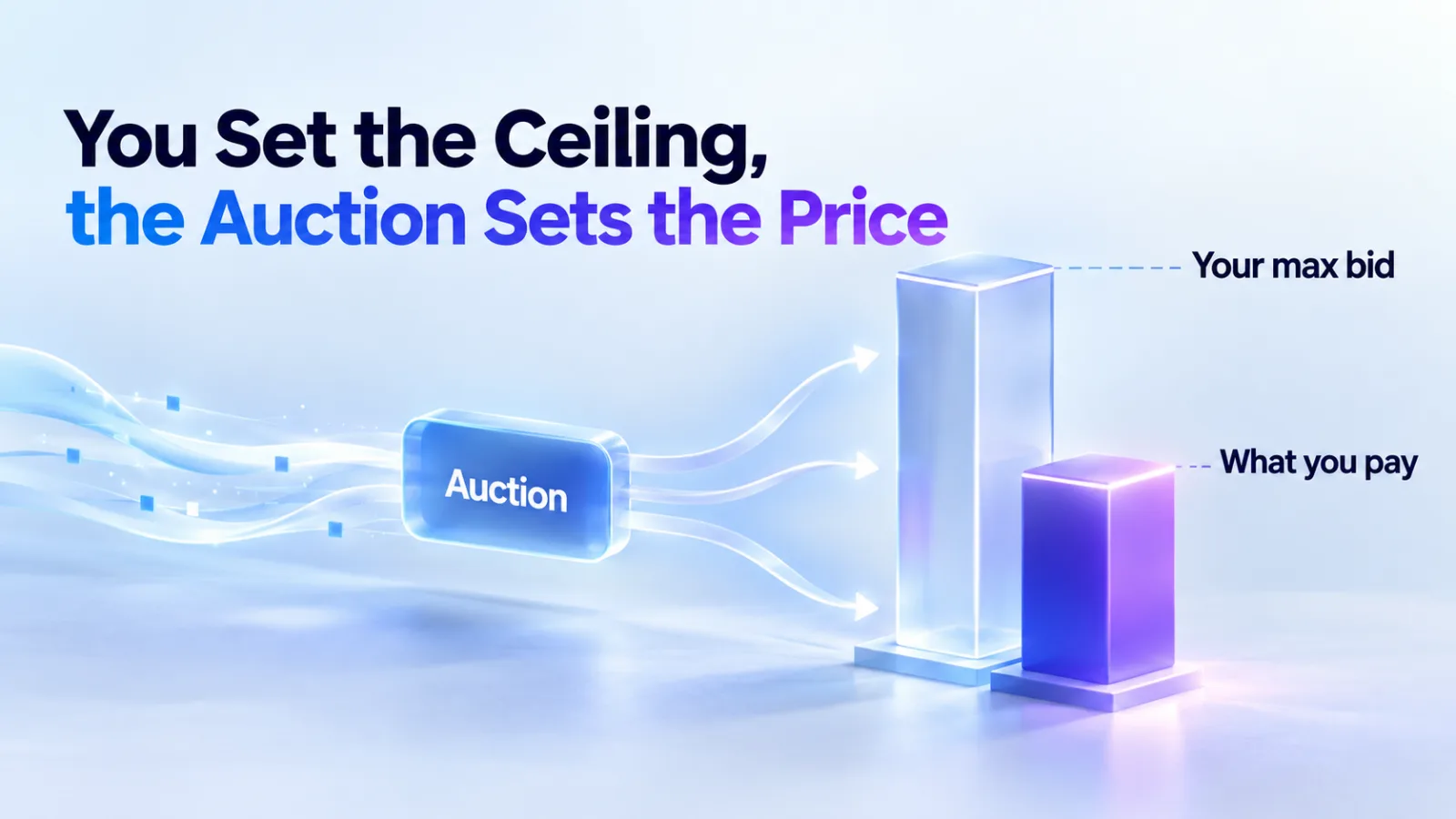
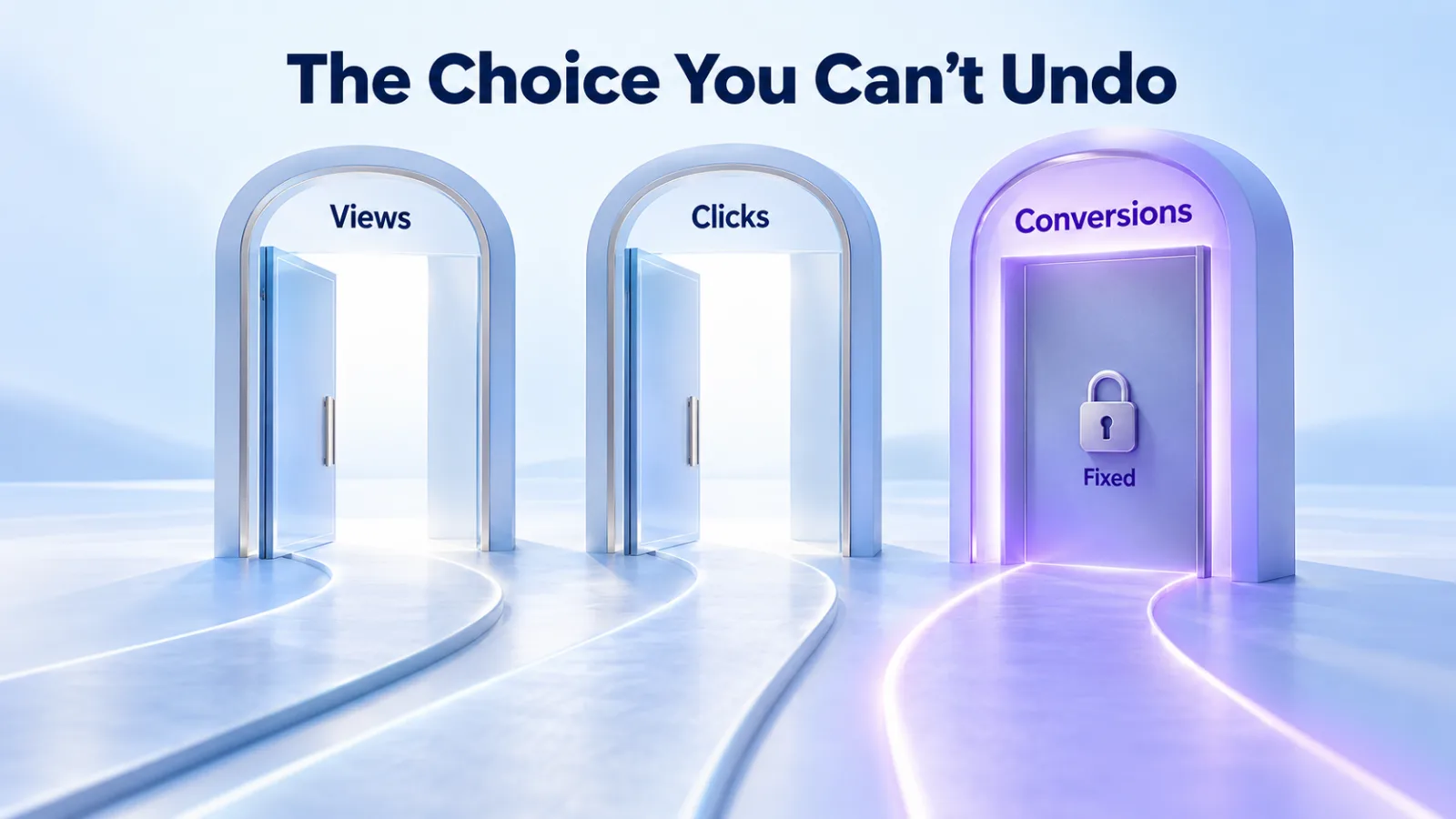
Every ChatGPT Ads campaign starts with a choice you can’t undo: the objective. It sets what you pay for and what the system tries to get you. Each ad group then needs a bid strategy, either a bid you set or one OpenAI adjusts for you. Here’s how the options work, what they cost you in control, and how we’d choose.
Checked against OpenAI’s Help Center and developer docs on 27 September 2026.
The three objectives
| Objective | You pay for | Delivery aims at |
|---|---|---|
| Views (CPM) | Every 1,000 impressions served. | Visibility: showing your ad as widely as your budget allows. |
| Clicks (CPC) | Each valid click. | People clicking through to your site. |
| Conversions | Valid clicks (oCPC) or every 1,000 impressions (oCPM), chosen at setup. | One standard conversion event you pick, such as a purchase or a lead. |
No objective charges per conversion. Even the Conversions objective bills per click or per impression; it changes who the system shows your ad to, not what you’re charged for.
Rules that can’t be changed later
- The objective is fixed. To switch, create a new campaign. Cloning a campaign creates a new one with a different objective or billing option; you can’t clone a Clicks campaign into another Clicks campaign.
- A Conversions campaign optimizes for one event, chosen at creation and fixed after. It must be a standard event, such as
order_createdorlead_created; custom events can’t be optimization goals. - Billing is fixed too. To move a Conversions campaign from click billing to impression billing, clone it and choose Impressions.
- Some budget changes are one-way. A campaign total budget can become a daily budget, but not back again.
Conversions: billed by click or by impression?
With click billing, you pay for valid clicks and delivery aims at conversions that follow a click. With impression billing, you pay for impressions and delivery aims at a broader set of conversions, including ones that follow a view of your ad without a click. OpenAI’s guide argues that impression billing finds more conversions and that choosing clicks “will lower your conversions”. Impression billing for this objective is still in beta, with access expanding.
Our view: the extra conversions from impression billing include view-through conversions, which are harder to check against your own analytics because there’s no click to trace. If you choose it, decide up front whether your targets count view-throughs, and read the separate click-through and view-through columns in Ads Manager.
On either billing option you set a bid cap, the most you’re willing to bid for a conversion. The system bids in each auction using its prediction of how likely a conversion is. The bid cap isn’t what you’re charged or a guaranteed cost per conversion, and OpenAI gives no recommended amount yet.
One difference between OpenAI’s sources: its API documentation lists click billing only for conversion campaigns, while the Ads Manager guide offers both. If you manage campaigns through the API or a partner tool, check which billing options it supports.
Bid strategies: fixed bid or Maximize Results
| Strategy | Works with | Budget | What you set |
|---|---|---|---|
| Fixed bid | Views, Clicks or Conversions | Daily or campaign total | A maximum bid, and audience bid adjustments if you want them. |
| Maximize clicks | Clicks | Daily only | No bid. OpenAI adjusts bids to get more clicks from your budget. |
| Maximize conversions | Conversions, billed per click | Daily only | No bid. OpenAI adjusts bids toward your conversion event. |
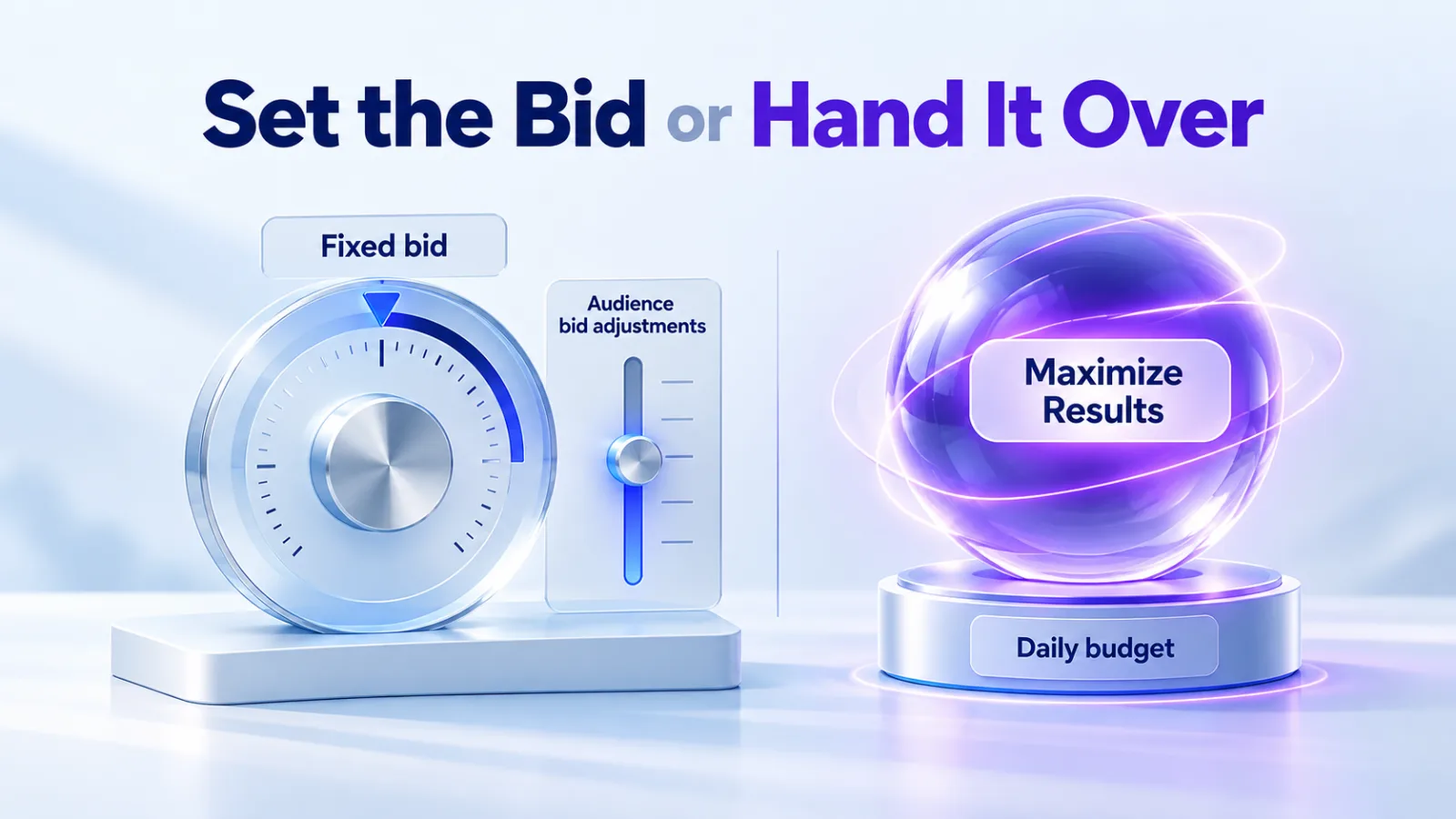
The trade-off is control. A fixed bid caps what you’ll pay and lets you bid more for people on your customer lists. Maximize Results takes the bid out of your hands and needs a daily budget, and audience bid adjustments aren’t allowed with it.
Setting the bid itself
- Clicks: OpenAI suggests starting maximum bids of $3–5 per click.
- Views: OpenAI publishes no CPM benchmark. In the API, CPM bids are sent per impression, so a $60 CPM becomes $0.06 per impression; that’s OpenAI’s arithmetic example, not a price.
- Conversions: no recommended bid cap. Start from what a conversion is worth to you.
- Budget floor: with fixed bids and a daily budget, the daily budget must be at least your highest effective bid, including audience adjustments. This doesn’t apply to Maximize Results or to campaign total budgets.
- Warnings: Ads Manager can flag bids that may limit delivery. OpenAI describes the low-bid flag as guidance, not a restriction.
To turn a conversion value into a bid, multiply it by your conversion rate: a $100 sale and a 3% conversion rate give a break-even cost per click of $3. The cost calculator does this for clicks and CPM, and each currency’s minimum daily budget is in our availability tracker.
How we’d choose
Our view, for a first campaign:
| Your situation | Start with |
|---|---|
| You want sales or leads, and your conversion event fires reliably and often | Conversions with click billing. Fixed bid cap if you want control, Maximize conversions if you’d rather not manage bids. |
| Tracking is live but conversions are rare | Clicks with a fixed bid, judged on the conversions your analytics records. OpenAI warns that rare events make performance harder to evaluate. |
| A launch or brand campaign where reach matters more than clicks | Views, with a clear idea of how you’ll measure the effect. |
| No conversion tracking yet | Set it up before you spend. You can’t judge any objective without it. |
Whatever you choose, change one thing at a time. Conversions take 24–48 hours to report, so a bid change on Monday can’t be judged on Tuesday. Our 30-day test plan sets out a schedule.
Questions
Can I switch a campaign from CPC to CPM?
Not in place. The objective can’t be changed after the campaign is created. Create a new campaign, or clone the old one and choose a different objective.
Do I pay per conversion with the Conversions objective?
No. You pay per valid click or per 1,000 impressions, depending on the billing option you chose. Your cost per conversion comes out of the auction.
What bid should I start with?
For click campaigns, OpenAI suggests starting maximum bids of $3–5. It gives no starting point for CPM or conversion bids, so work back from what a conversion is worth to you.
Is Maximize Results better than a fixed bid?
OpenAI hasn’t published a comparison. Maximize Results saves you managing bids but needs a daily budget and doesn’t allow audience bid adjustments. A fixed bid gives you a ceiling on price.
Want someone to set bids and budgets against your numbers? See our ChatGPT Ads management service.
Sources
- Create campaigns, OpenAI Help Center
- Conversion-optimized campaigns, OpenAI Help Center
- Ads in ChatGPT: the basics and Daily budgets, OpenAI Help Center
- Measure results, OpenAI Help Center
- Bidding and budgets, OpenAI developer docs
All sources checked on 27 September 2026.