On paper, ChatGPT Ads and Google Ads look alike: both run auctions, both sell clicks, both average out daily budgets. The difference is in how an ad gets matched. Google matches ads to what people search for; ChatGPT matches them to what people are talking about. That changes how you target, what you write and which businesses benefit.
Checked against OpenAI’s and Google’s own documentation on 27 September 2026. Where we give an opinion, we say so.
At a glance
| Topic | ChatGPT Ads | Google Ads |
|---|---|---|
| Where ads show | Below ChatGPT’s answers, labeled Sponsored, for people on the Free and Go plans. | On Google Search results, including above and below AI Overviews, and inside them in 12 countries, in English. |
| Matching | The conversation’s context and intent, your landing page and copy, and context hints. No keywords. | Keywords with broad, phrase or exact match, plus keywordless options such as AI Max and Performance Max. |
| Exclusions | No negative keywords, and hints can’t exclude conversations. Locations and customer lists can be excluded. | Negative keywords stop ads showing on searches that contain a term. |
| Auction | Relevance-weighted, second-price: relevance and bids decide which ad shows first. | Ad Rank from six factors, including the bid, ad and landing-page quality, ad assets and the context of the search. |
| Budgets | A daily budget averages over seven days: up to twice it on one day, no more than seven times it in seven days. | An average daily budget: up to twice it on one day, and no more than 30.4 times it in a month, for most campaigns. |
| Sensitive topics | No ads near sensitive or regulated topics such as personal health, mental health or politics. | No ads inside AI Overviews for sensitive categories such as adult, alcohol, gambling, finance, healthcare and politics. |
Conversations versus searches
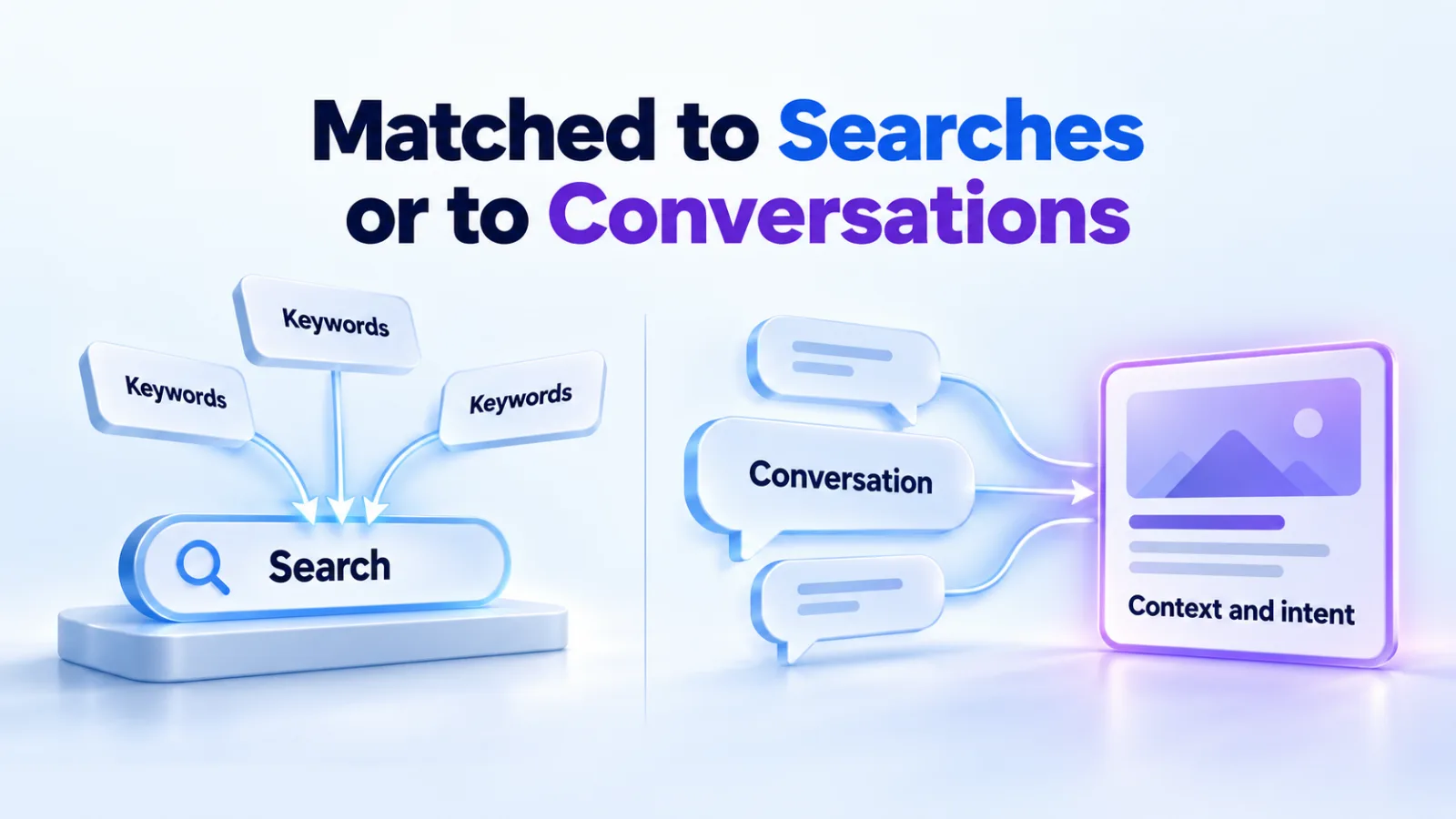
Google Ads starts from the search. Keywords match ads to the terms people type, and the match type decides how closely a search has to fit: exact match for specific searches, broad match for a wider range of related ones.
ChatGPT Ads starts from the conversation. OpenAI describes people coming to ChatGPT with goals, explaining what they want to accomplish, what matters to them and the constraints they face. Its ads system considers the context and intent of that conversation, the ad’s landing page, title and copy, and the context hints you write, plus signals from wider ChatGPT use when someone has ads personalization on.
Our view: Google is strongest when people already know what to search for, and ChatGPT reaches them earlier, while they’re still weighing options and describing their situation.
Targeting: hints versus keywords
The biggest practical change for a Google advertiser is losing keyword control. In ChatGPT Ads you have:
- Context hints on each ad group, describing what you offer, who it helps and when. OpenAI says they inform relevance but aren’t targeting rules and can’t enforce exclusions. See our context hints guide.
- Location targeting, with places to include and exclude.
- Platform targeting across the iOS app, the Android app and the web.
- Custom audiences from your own customer lists, for targeting, bid adjustments or exclusions. OpenAI’s planning threshold for targeting and bid adjustments is 25,000 matched users, and custom audiences can’t be used for campaigns targeting the EEA or Switzerland.
Google’s keyword tools don’t have a ChatGPT equivalent. There are no match types and no negative keywords, so a Google keyword list doesn’t port across. Rewrite it as the situations those searches come from.
Costs and budgets
Both platforms price ads at auction, so what you pay depends on who else is bidding. Google says your actual cost per click is often less than your maximum bid. OpenAI prices through a relevance-weighted, second-price auction and gives one starting point: maximum bids of $3–5 for click campaigns. In the US, a ChatGPT campaign needs at least $25 a day.
Budget pacing is strikingly similar. Both let a day spend up to twice the daily budget. Google caps a month at 30.4 times the average daily budget for most campaigns; OpenAI caps each seven days at seven times the daily budget. Either way, plan spend as about 30.4 days of budget a month. Our cost guide and calculator cover the ChatGPT side in detail.
Ads inside AI answers
The two companies have made opposite choices here. Google now shows ads inside AI Overviews, as well as above and below them. Inside the overview, Google considers both the search and the overview’s content, and the ads come from existing Search, Shopping and Performance Max campaigns. For now that’s in English, in 12 countries including the US, and Google says it needs broad match or keywordless targeting to find those moments.
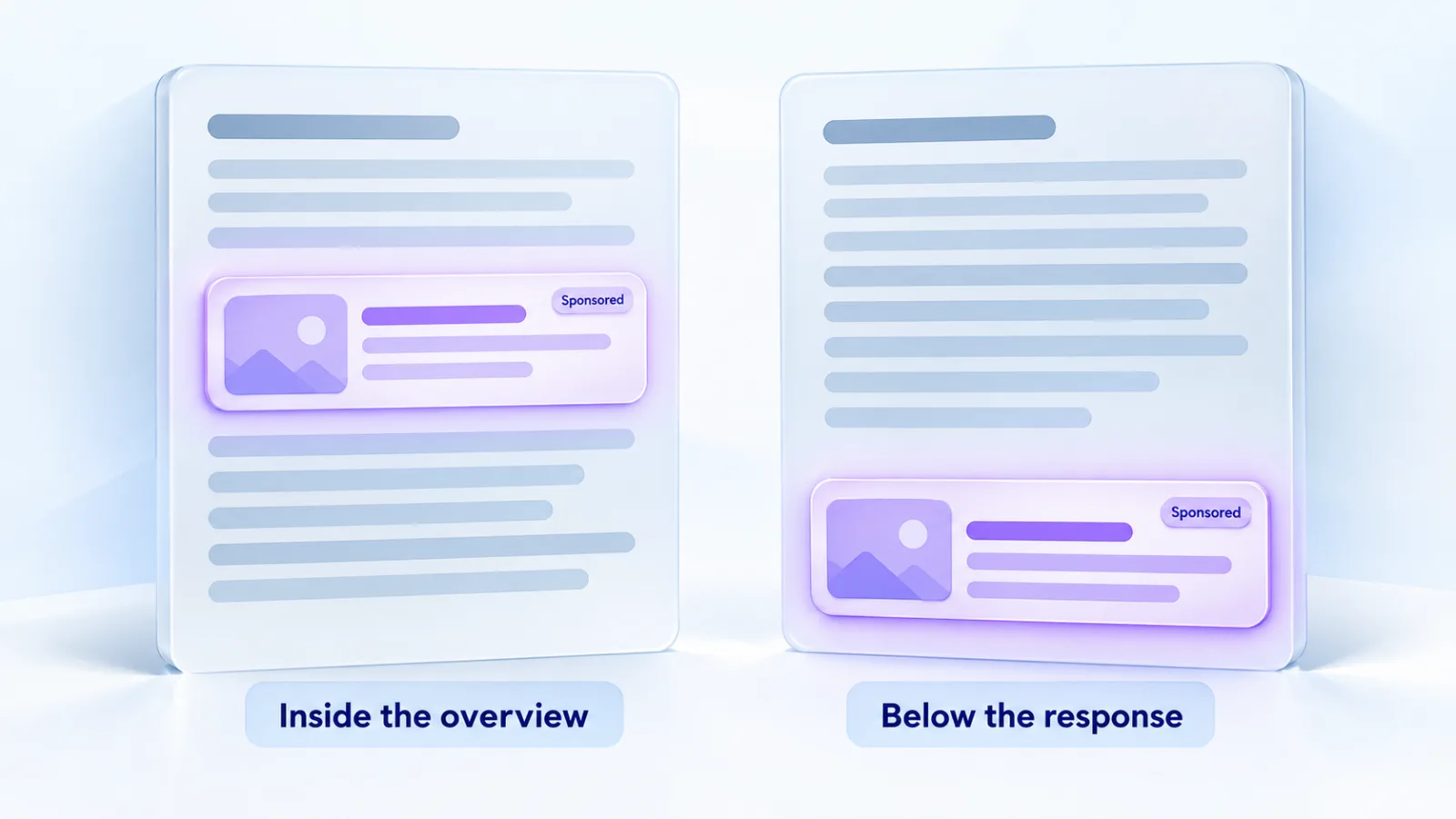
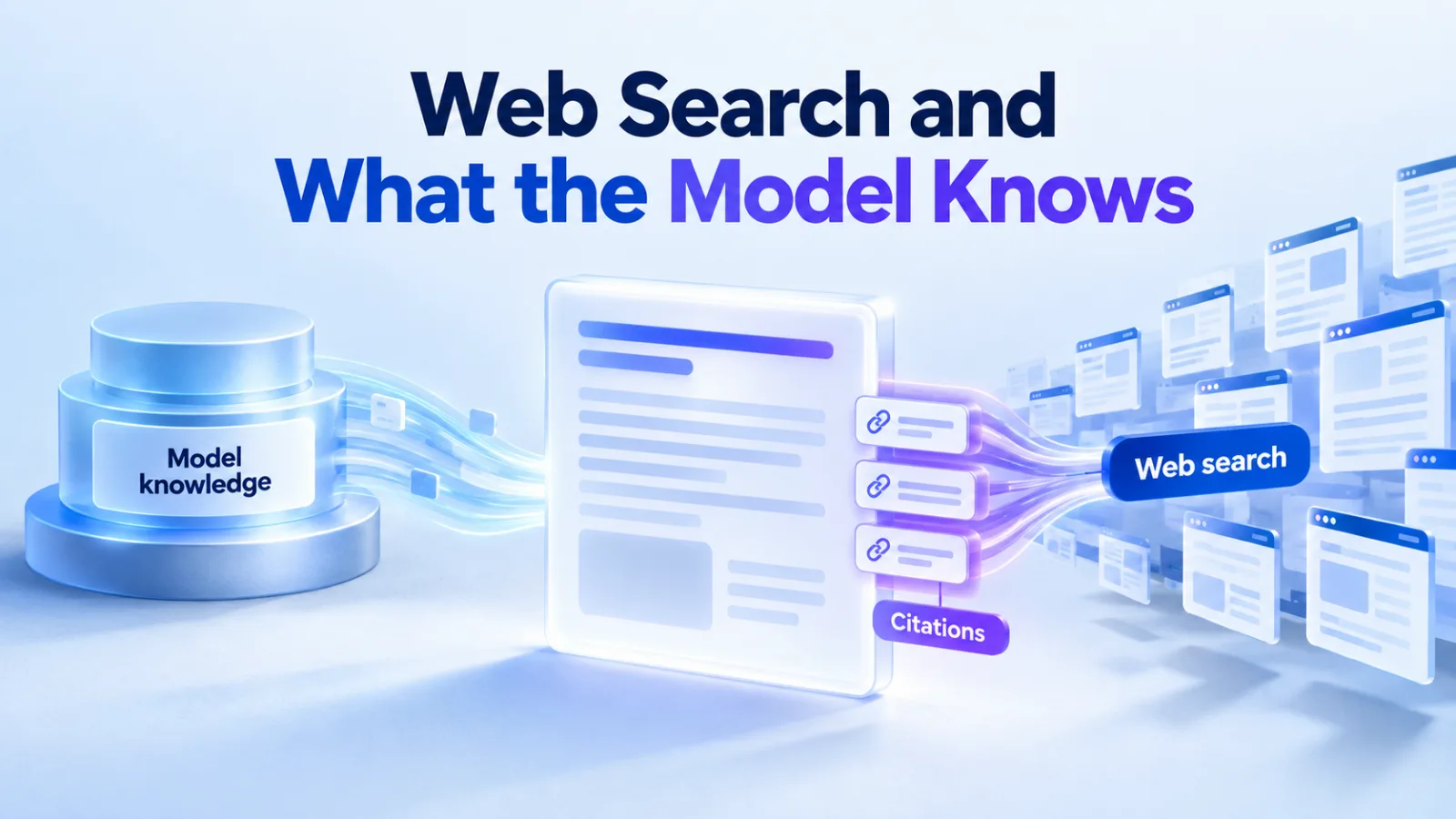
OpenAI keeps ads out of ChatGPT’s answers. Ads appear below the end of a response, clearly labeled and visually separate, and OpenAI says ads run on systems separate from its chat model, so advertisers can’t shape, rank or change ChatGPT’s responses.
Measurement
ChatGPT Ads measures conversions through OpenAI’s Measurement Pixel and Conversions API, with click-through windows of 7, 14 or 30 days and an optional one-day view-through window, using last-touch attribution. Attributed conversions take 24–48 hours to appear. If you run both channels, tag every ChatGPT ad with its own UTM parameters and compare both channels in your own analytics, on the same dates and time zone. Our conversion tracking guide has the setup.
Which should you try first?
This is our view, based on how the two platforms work:
- Start with Google if people already search for what you sell and you aren’t yet showing up for those searches.
- Add ChatGPT Ads if buyers research and compare before they buy, your category is allowed, your customers are likely to use ChatGPT’s Free or Go plans, and you can track conversions on your site.
- Hold off on ChatGPT Ads if your category is disallowed, your buyers mostly use ChatGPT through work Business or Enterprise plans, which never show ads, or your budget can’t fund a test that runs for weeks.
If you run both, keep separate budgets, and judge each against the same conversion data in your own analytics.
Questions
Can I import my Google Ads campaigns?
We haven’t seen an import from Google Ads in OpenAI’s documentation, and keywords wouldn’t carry over as keywords anyway. Build campaigns in Ads Manager and turn your best search themes into context hints.
Are ChatGPT Ads cheaper than Google Ads?
There’s no reliable general answer. Both are auctions, so prices depend on competition in your category. Test ChatGPT Ads with a budget you can judge, and compare cost per conversion on your own data.
Can I use the same landing pages?
Usually, as long as they load and don’t block OpenAI’s crawlers, OAI-AdsBot and OAI-SearchBot. OpenAI recommends sending each ad to the most relevant page rather than your homepage.
Who sees ChatGPT ads?
People on the Free and Go plans, and in logged-out ChatGPT. Plus, Pro, Business, Enterprise and Edu accounts don’t see ads, and neither do accounts identified as under 18.
Not sure where your budget should go first? Tell us about your business and we’ll give you a straight answer.
Sources
- Ads in ChatGPT and Ads in ChatGPT: the basics, OpenAI Help Center
- Daily budgets and Write context hints, OpenAI Help Center
- Targeting and Custom audiences, OpenAI developer docs
- ChatGPT Ads expands to Southeast Asia and Taiwan, OpenAI, 23 September 2026
- About ads and AI Overviews, Google Ads Help
- About keyword matching options, Google Ads Help
- How the Google Ads auction works, Google Ads Help
- About average daily budgets, Google Ads Help
All sources checked on 27 September 2026.