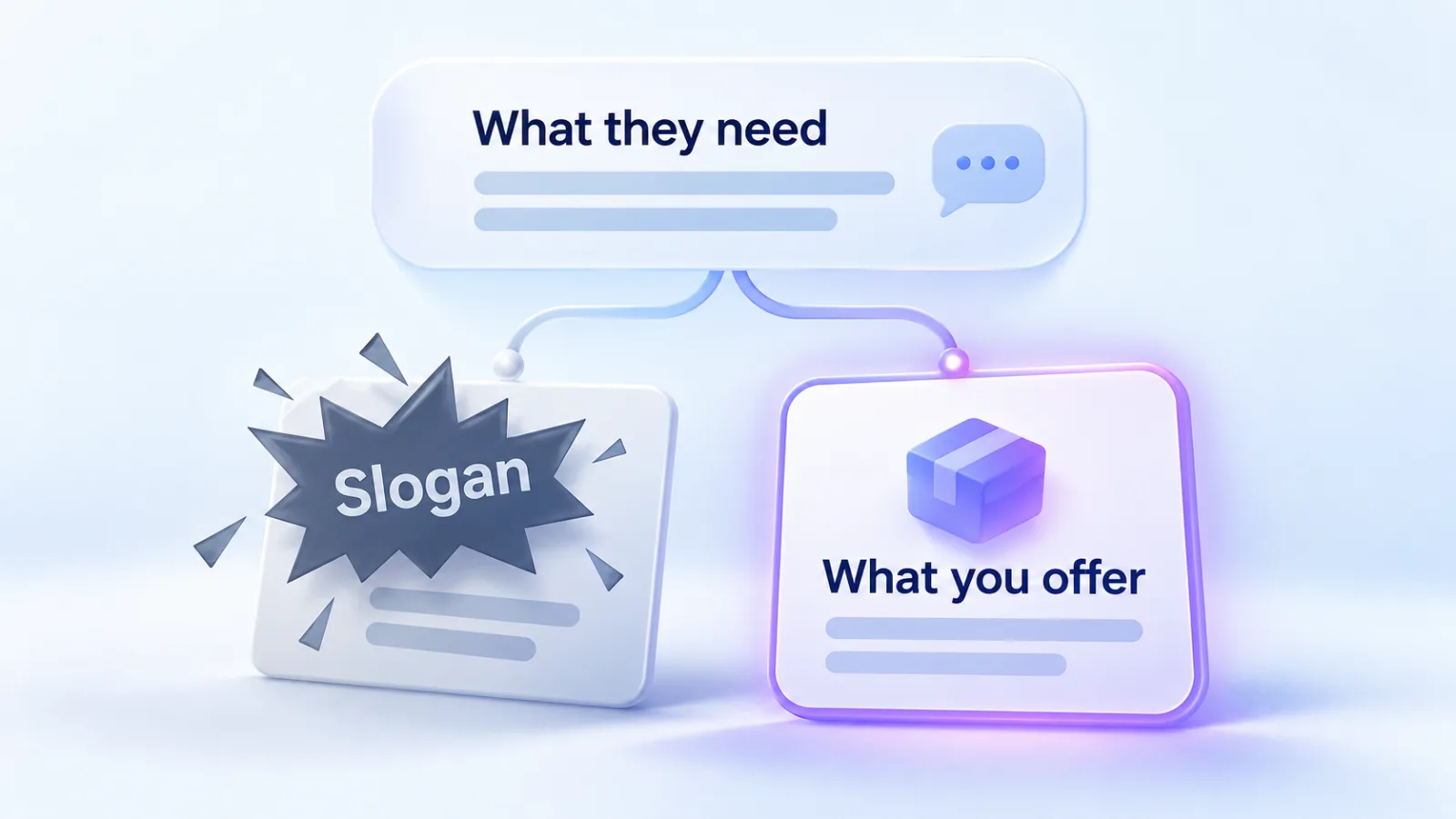

Good ChatGPT context hints describe a situation your offer fits, in one natural phrase. Weak ones list keywords, repeat the ad or try to give delivery instructions. Below are 30 example hints across ten industries, each built on OpenAI’s what, who and when framework. They’re illustrations we wrote, with no real brands or results behind them.
Every platform fact links to OpenAI’s documentation. The example hints are illustrative, and where we give our own view, we say so.
What good ChatGPT context hint examples have in common
Context hints are short descriptions you add to an ad group. OpenAI says they share details about your business that help its systems understand when your ads may be relevant. They guide relevance, but they aren’t targeting rules or delivery instructions.
| OpenAI’s test | What it asks |
|---|---|
| Additional | Does it add something the ad and landing page don’t already make clear? |
| Specific | Does it name a concrete feature, need or situation? |
| Relevant | Is there a genuine link between the offer and the situation? |
| Accurate | Is it true today, including prices, availability and service areas? |
OpenAI suggests writing around three angles: what you offer, who it helps and when it’s useful. Each hint should be one clear, natural phrase about one idea. It doesn’t need to cover all three angles. Our context hints guide explains the method in full.
OpenAI’s own examples
OpenAI’s guide gives a few examples, and they set the standard for everything below.
| What it shows | Hint |
|---|---|
| Product, person and moment | Cushioned everyday running shoes for beginners training for their first 5K |
| A precise problem | Bookkeeping software for growing retailers that need to reconcile online and in-store sales |
| The business and its area | Residential plumbing services available in Chicago |
OpenAI contrasts the Chicago hint with “Show this ad only to people in Chicago”. That second phrase is a delivery instruction, and hints can’t enforce it. Location targeting restricts where ads show.
Ecommerce: fashion and accessories
| Angle | Example hint |
|---|---|
| What | Waterproof leather boots with a wide-fit option, delivered in two days |
| Who | Commuters who walk to work in wet weather and want boots that pass for office shoes |
| When | Replacing winter boots before a first snowy season in a new city |
Weak version: “boots, winter boots, waterproof boots”. It reads like a keyword list and adds nothing the ad doesn’t say.
Home and furniture
| Angle | Example hint |
|---|---|
| What | Modular sofas that arrive in boxes and fit through narrow stairwells |
| Who | Renters in small flats who move every year or two |
| When | Furnishing a first apartment on a budget |
The “who” hint names a circumstance, not a demographic. OpenAI notes that wanting to reach a group doesn’t, by itself, make an offer relevant.
Software and SaaS
| Angle | Example hint |
|---|---|
| What | Project planning software with client approval steps and time tracking |
| Who | Design agencies of 5 to 30 people managing several client projects at once |
| When | Moving a growing team off spreadsheets after missing client deadlines |
Weak version: “best project management software”. Comparison words don’t describe your product. Business software also faces an audience limit: ads don’t show on Business or Enterprise accounts.
Business services: accounting
| Angle | Example hint |
|---|---|
| What | Monthly bookkeeping and year-end accounts for limited companies |
| Who | Founders of new companies who have just hired their first employee |
| When | Preparing for a first company tax return without an in-house finance team |
Each hint stays on one idea. Splitting “who” and “when” into separate hints keeps them readable and testable.
Local and home services
| Angle | Example hint |
|---|---|
| What | Roof leak repairs with same-week inspections across north Manchester |
| Who | Homeowners in older terraced houses with recurring damp in upstairs rooms |
| When | Finding a roofer after storm damage before an insurance claim |
The service area belongs in the hint as a fact about the business. To limit delivery to that area, use location targeting.
Education and online courses
| Angle | Example hint |
|---|---|
| What | Self-paced data analysis course using Excel and SQL, with weekly mentor reviews |
| Who | Career changers from retail or hospitality moving into office analyst roles |
| When | Building skills for a first analyst job application in the next three months |
Avoid promising outcomes. OpenAI’s ad policy bans unfounded claims about results, and hints should be as accurate as ads.
Travel and hospitality
| Angle | Example hint |
|---|---|
| What | Boutique hotel in Porto’s old town with a rooftop terrace and late check-out |
| Who | Couples planning a short anniversary trip who want somewhere quiet and central |
| When | Booking a long weekend away with less than a month’s notice |
Travel and experiences are among the consumer categories OpenAI says ads focus on during the initial period.
Pets
| Angle | Example hint |
|---|---|
| What | Grain-free food for large breeds, delivered monthly in resealable bags |
| Who | Owners of large dogs who don’t want to carry heavy bags home |
| When | Switching a puppy to adult food as it reaches full size |
Keep health claims out. Our view: a hint about convenience and size is accurate, while a hint promising health results invites a rejection.
Automotive services
| Angle | Example hint |
|---|---|
| What | Electric vehicle servicing and tyre changes at home, with no trip to a garage |
| Who | EV owners who can’t take time off work for a service appointment |
| When | Booking a first service when an EV’s warranty check falls due |
Legal services (US only)
| Angle | Example hint |
|---|---|
| What | Fixed-fee trademark registration for small businesses in the US |
| Who | Founders launching a product who want to protect the brand name first |
| When | Checking a new business name before printing packaging or signing a lease |
OpenAI’s ad policy allows legal services in the US only, from advertisers licensed in the jurisdiction where the ad shows. Our law firms guide covers the rules.
From keywords to context hints
If you come from search ads, start from your best keywords and ask what situation each one stands for. The rewrites below are our own illustrations.
| Keyword habit | Situation hint |
|---|---|
| crm for small business | A CRM for agencies of 5 to 50 people that bill on monthly retainers |
| emergency plumber near me | Same-day leak repairs for flats and houses in south London |
| cheap flights to rome | Flight and hotel packages to Rome for families during school holidays |
| online spanish course | Spanish lessons for adults preparing for a trip in the next few months |
| buy running shoes | Cushioned running shoes for beginners training for their first 5K |
OpenAI says people don’t need to use the words in your hint for the need or situation to be relevant. That’s the main difference from keywords.
What doesn’t work
These hint styles fail OpenAI’s guidance. Each looks reasonable at first, which is why they’re common.

| Style | Example | Why it fails |
|---|---|---|
| Keyword list | sofa, couch, sectional | Not a natural phrase about one idea |
| Delivery instruction | Show this ad only to people in Chicago | Hints can’t enforce locations, schedules or exclusions |
| Exclusion | Not for people looking for free tools | OpenAI says hints can’t enforce exclusions |
| Wishful audience | Ideal for CEOs of large companies | Wanting a group doesn’t make the offer relevant |
| Repeated title | Beginner running shoes | Adds nothing beyond the ad |
| Stale fact | 20% off until the end of March | Inaccurate once the offer ends |
One story from hint to landing page
A hint works best when the ad and the landing page tell the same story. OpenAI’s creative guidance asks for the most relevant page, and its policy asks that ads be consistent from end to end. The table follows one illustrative ad group through.
| Element | Example |
|---|---|
| Hint | Roof leak repairs with same-week inspections across north Manchester |
| Hint | Finding a roofer after storm damage before an insurance claim |
| Title | Storm damage roof repairs |
| Copy | Same-week inspections and photos for your insurer |
| Landing page | A storm repair page with the booking form and service area map |
Every element mentions the same situation. A reader who clicks from a storm question lands on a page about storms, not the homepage. Our ad examples show the same pattern across eight industries.
How to organize hints in ad groups
OpenAI suggests grouping hints around a shared product, service, theme or customer need. It says to consider separate ad groups when use cases need different messages or landing pages.
We’d give each ad group the situations for one offer, with the landing page that fits them. A roofer might run one ad group for storm repairs and one for planned replacements. Each gets its own hints, ads and page.
One technical point matters if you use bulk upload. An uploaded list of hints replaces the old list. It isn’t merged, so always upload the complete list for that ad group.
Testing your own hints
OpenAI publishes no report by hint, so this method is ours. Test hints the way you test ads: by ad group. Put a new set of situations in a new ad group with matching ads and a matching page. After two weeks, compare impressions, click-through rate and cost per conversion against the original group.
Keep the groups that earn their keep and rewrite the rest. Update hints whenever prices, availability or service areas change, as OpenAI asks. Before you upload, run your list through our context hint checker.
Questions
How many context hints should an ad group have?
OpenAI doesn’t give a number. Keep each hint to one idea, and keep all the hints in an ad group about the same offer or need. If you’re listing unrelated situations, split them into a second ad group with its own ads and landing page.
Can I use context hints to exclude conversations?
No. OpenAI says context hints can’t enforce geographic limits, schedules or exclusions. Phrases like “not for” don’t work as negative keywords. Use location targeting and custom audience exclusions instead. Negative Phrases, which OpenAI announced on 5 October 2026, are a separate control for qualifying advertisers.
Do people need to use the words in my hint?
No. OpenAI says people don’t need to use the exact words in your hint for the need or situation to be relevant. Describe the situation clearly, and the system judges relevance from the conversation’s meaning. So plain, specific phrases beat lists of synonyms.
Should hints include prices and offers?
They can, if the details are accurate and useful. OpenAI lists pricing among the things a “what” hint can describe. Update hints when prices, promotions, availability or service areas change, so a hint never describes an offer that has ended.
Can I reuse these example hints?
Use them as patterns and write your own. They’re illustrations for invented businesses. Your hints should describe your own offer, customers and situations, in your own words, and pass OpenAI’s four tests. A borrowed hint that isn’t accurate for your business fails the last test.
Are hints the same as targeting?
No. Hints inform relevance; targeting restricts delivery. ChatGPT Ads targeting covers locations, platforms and custom audiences, set on the campaign. Hints sit on the ad group and describe situations. You need both: targeting decides who can be reached, and hints help decide which conversations fit. Our targeting guide explains each control.