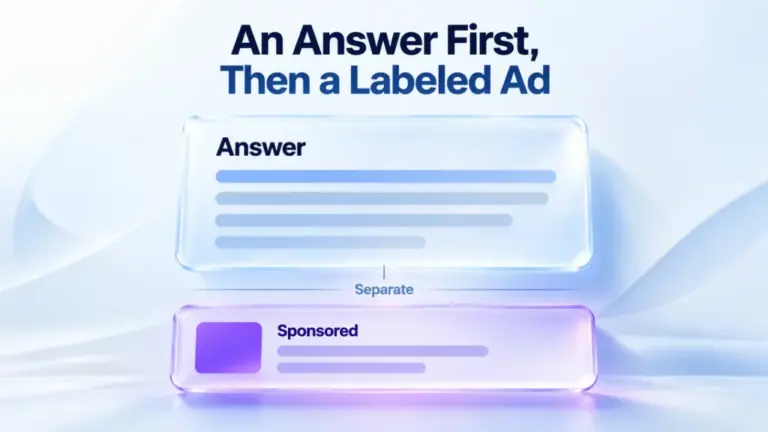
ChatGPT Ads are paid, labeled placements that appear below ChatGPT’s answers for people on the Free and Go plans. OpenAI picks each ad by its relevance to the conversation, and says ads never change what ChatGPT answers. Businesses buy them through an auction, mostly in OpenAI’s self-serve Ads Manager. This guide explains how they work for the people who see them and the businesses that buy them.
Every platform fact links to OpenAI’s documentation. Where we give our own view, we say so.
What ChatGPT Ads are, in short
| Question | Short answer |
|---|---|
| Where do they appear? | Below the end of a ChatGPT response, labeled as sponsored |
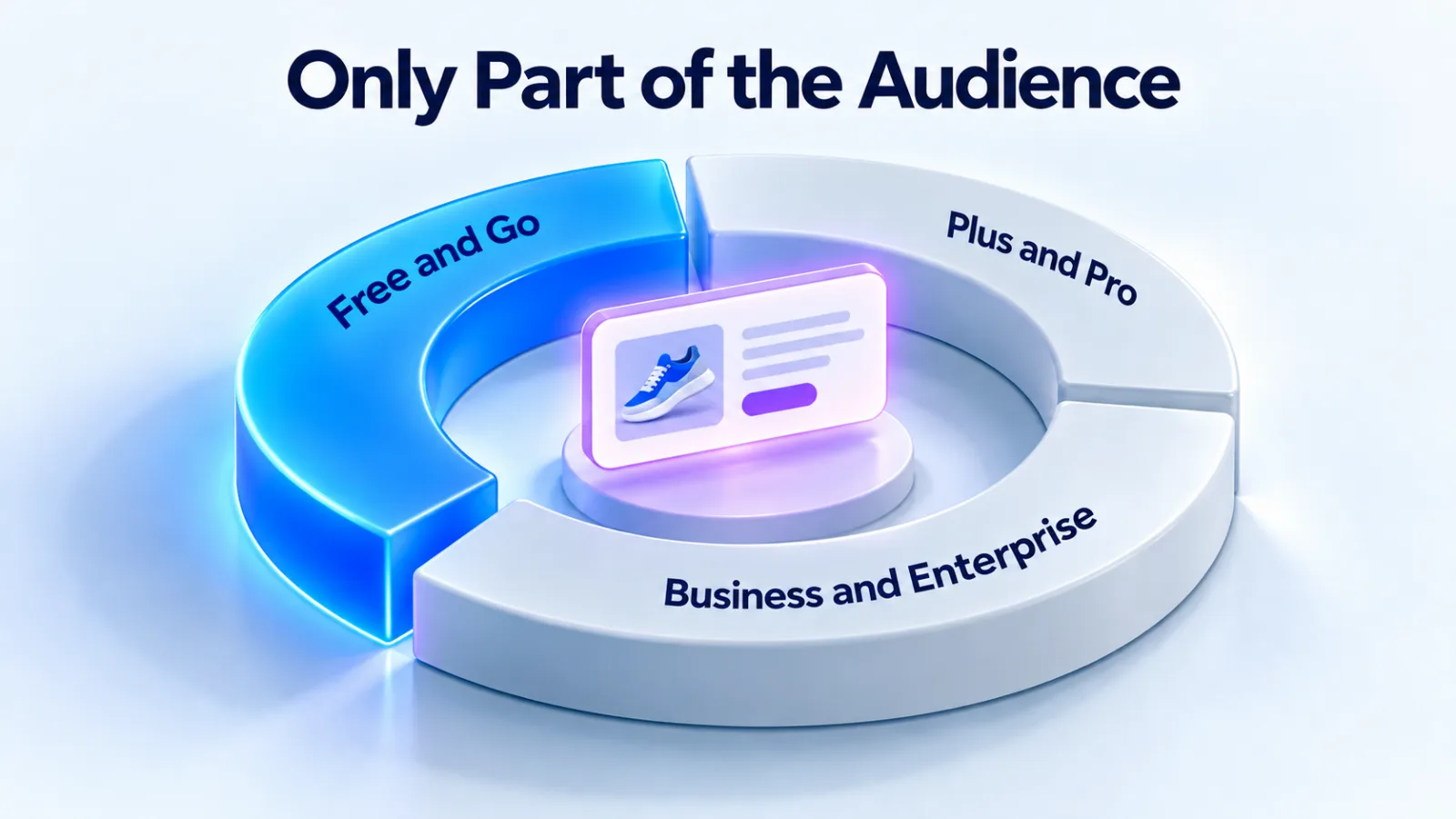
| Who sees them? | Free and Go users and logged-out users; not Plus, Pro, Business, Enterprise or Edu, and not under-18s |
| How are they chosen? | By relevance to the conversation, with advertiser bids deciding order among eligible ads |
| Do they change answers? | No. OpenAI says ads run on separate systems from the chat model |
| Who can advertise? | Eligible businesses in 63 countries through Ads Manager, or through OpenAI’s team and partners |
| How are they priced? | An auction, paid per 1,000 impressions or per click |
When ads started
OpenAI announced plans to test ads on 16 January 2026, alongside the US launch of its lower-cost Go plan. Testing began in the US on 9 February 2026. Since then ads have spread to more than 60 countries.
| Date | What happened |
|---|---|
| 16 January 2026 | OpenAI announces it will test ads for Free and Go users in the US |
| 9 February 2026 | Testing starts in the US for logged-in adults on Free and Go |
| 5 May 2026 | Self-serve Ads Manager beta, CPC bidding and partner buying |
| August 2026 | Ads launch in the UK, Mexico, Brazil, Japan, South Korea and 31 European markets |
| 23 September 2026 | Seven more markets in Southeast Asia and Taiwan |
Our ChatGPT Ads updates timeline keeps the full list, with every policy and product change.
Where ads appear and what they look like
Ads appear below the end of a response, clearly labeled as sponsored and visually separate from it. A response can show one or more ad units when there’s a relevant match. A unit may feature one or more items from one advertiser, or from several.
Each ad has the advertiser’s name and logo, a title, a short description, an image and a link. Stores can also run product ads from a catalog, with prices and ratings. OpenAI is testing Sponsored Agents too, where someone can start a labeled chat with a business’s AI representative after clicking an ad. In October 2026 it also announced a visual format, to be tested during image generation.
Ads don’t appear in Temporary Chats, and during the test they don’t appear in the ChatGPT Atlas browser. Our ad examples show what ads can look like across industries.
Who sees ChatGPT ads
Ads may appear for people on the Free and Go plans. Plus, Pro, Business, Enterprise and Edu accounts don’t get ads. OpenAI doesn’t show ads to accounts identified as belonging to people under 18. It uses account age information and age prediction where available.
People using ChatGPT logged out can see ads too, limited to ads suitable for all audiences. Mature-content ads are limited to eligible logged-in users. Our guide to who sees ChatGPT ads covers the details by plan and age.
How an ad is chosen
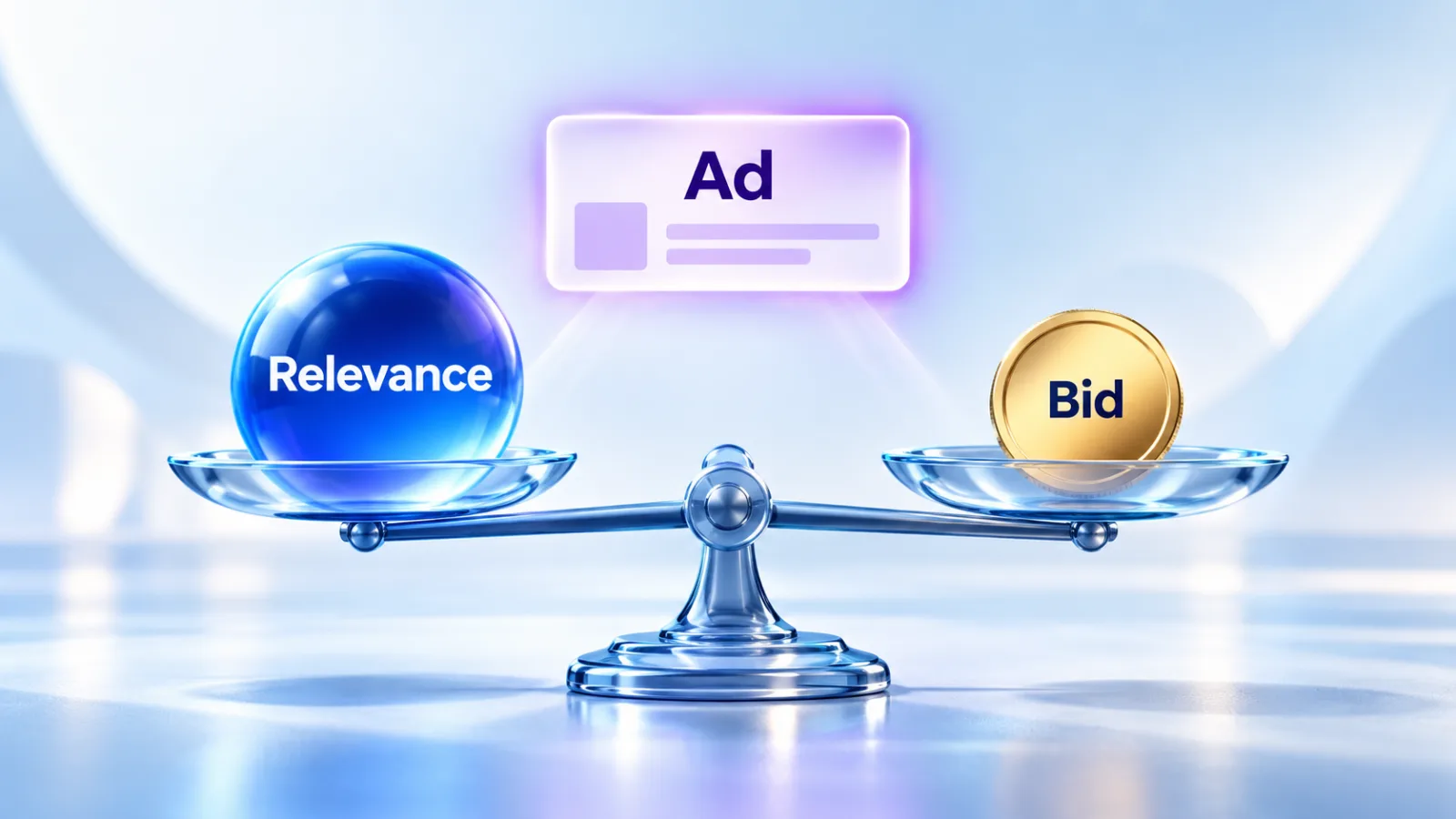
OpenAI’s ads system selects ads by expected relevance and outcomes. It weighs several signals:
- The context and intent of the current conversation.
- The ad’s landing page, title and copy.
- The advertiser’s context hints and targeting choices.
- With ad personalization on, select signals from the person’s wider ChatGPT use.
When several ads are eligible, OpenAI considers relevance and advertiser bids to decide which shows first. There are no keywords. Advertisers write context hints that describe the situations their offer fits, and OpenAI says hints aren’t exact-match keywords. Our context hints guide explains how to write them.
The principles OpenAI set for ads
OpenAI published five principles when it announced ads in January 2026. They explain most of the rules advertisers meet later.
| Principle | What OpenAI commits to |
|---|---|
| Mission alignment | Advertising supports making AI more accessible |
| Answer independence | Ads don’t influence answers, and are separate and clearly labeled |
| Conversation privacy | Conversations stay private from advertisers, and user data is never sold |
| Choice and control | People control personalization, can clear ads data and can avoid ads |
| Long-term value | OpenAI doesn’t optimize for time spent, and puts trust before revenue |
Do ads change ChatGPT’s answers?
No. OpenAI says ads don’t influence ChatGPT’s answers, and run on separate systems from the chat model. Advertisers can’t shape, rank or alter responses. Product results in ChatGPT shopping aren’t ads either.
Seeing an ad also doesn’t mean OpenAI endorses the advertiser. By default, ChatGPT can’t see the ads shown to you. If you want to ask about one, you can share it with ChatGPT through the ad’s menu.
What advertisers can and can’t see
Advertisers don’t get people’s conversations. OpenAI says advertisers have no access to chats, chat history, memories, names, email addresses, precise locations or IP addresses. During the test, they receive aggregated reporting such as views and clicks.
Ads can use information that stays inside ChatGPT. That includes the current conversation and basic context such as general location and language. With personalized ads on, it can include past chats, memory and how someone interacts with ads. Personalized ads aren’t initially available in the European Economic Area or Switzerland.
If someone chooses to message an advertiser through an ad, the advertiser sees only the messages sent to it directly.
What users can control
Free and Go users get ad controls in ChatGPT’s settings. OpenAI lists these options:
| Control | What it does |
|---|---|
| Hide ad | Dismisses an ad from its three-dot menu |
| Report ad | Flags an ad as misleading, unsafe or inappropriate, and hides it |
| About this ad | Explains why an ad is showing |
| Ask ChatGPT | Shares the ad with ChatGPT so you can ask about it |
| Personalize ads | Turns personalization off. Ads then use only the current chat |
| Delete ads data | Clears ads history and topics, removed within 30 days |
| Ads-Free on Free | Removes ads in exchange for lower usage limits and fewer tools |
The other way to avoid ads is an ad-free paid plan, such as Plus or Pro. Turning off personalization isn’t the same as going ad-free: it changes how ads are chosen, not whether they appear.
What can’t be advertised
OpenAI’s ad policy keeps ads away from sensitive or regulated conversations. Ads aren’t eligible near topics such as personal health, mental health or politics. Political advertising isn’t allowed at all.
Some categories are disallowed, including gambling, alcohol and tobacco, adult content and recreational drugs. Financial, health and legal services are allowed only under eligibility rules that vary by market. Our policy tracker lists every category by country.
How businesses buy ChatGPT Ads
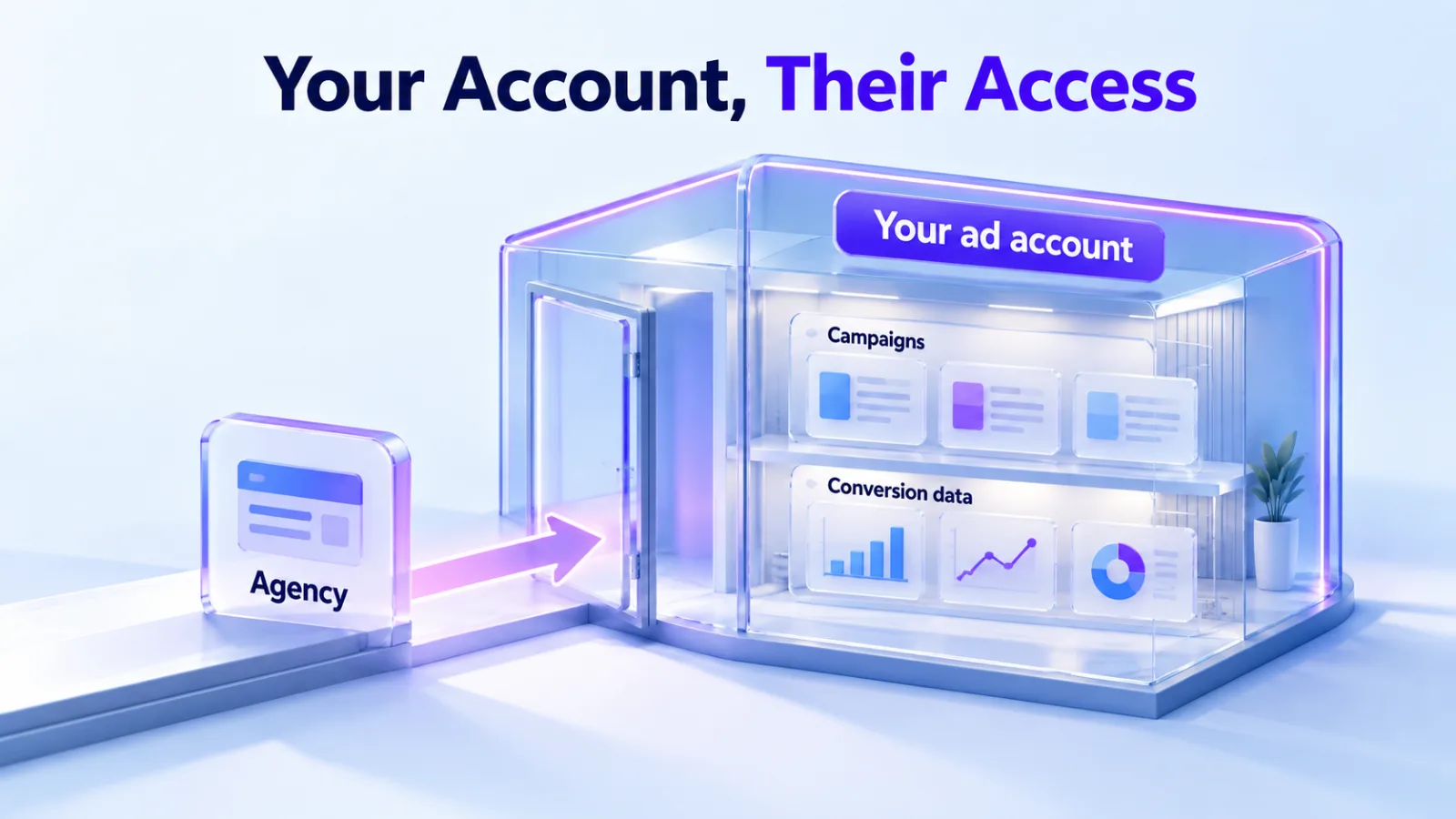
Businesses can buy in three ways. Most use Ads Manager, OpenAI’s self-serve platform. Larger advertisers can work with OpenAI’s Ads Solutions team, or through agency and technology partners.
| Part | What to know |
|---|---|
| Where to sign up | ads.openai.com |
| Who can sign up | Businesses whose legal entity is based in one of the 63 available countries |
| How pricing works | A relevance-weighted, second-price auction |
| How you pay | Per 1,000 impressions or per valid click; never per conversion |
| Suggested starting bid | $3 to $5 per click, for click campaigns |
| Minimum budget | A minimum daily budget per campaign, such as 25 USD |
Our step-by-step setup guide covers the process, and the cost guide explains billing. The Ads Manager guide tours the platform itself.
How ChatGPT Ads differ from search and social ads
We’ve made this comparison from OpenAI’s documentation. The buying model looks familiar: campaigns, bids, budgets and a pixel. What triggers the ad is different.
| ChatGPT Ads | Search ads | Social ads | |
|---|---|---|---|
| Trigger | The meaning of a conversation | Keywords in a search | Audience and interest profiles |
| Placement | Below an answer | Above and beside results | In a feed |
| Main targeting | Context hints, location, platform, customer lists | Keywords, location, audiences | Demographics, interests, lookalikes |
| Who’s excluded | Paid plans, work accounts and under-18s | Few | Varies by platform |
Our comparison with Google Ads goes into each difference.
Why businesses are paying attention
OpenAI says ChatGPT Ads reached a $1 billion annualized revenue run rate in under 200 days. It says tens of thousands of advertisers use it. It also says ChatGPT reaches 1.2 billion people each week, though only Free and Go users see ads.
Our view: the opportunity is the moment of the ad. People describe their goals and constraints in ChatGPT before they decide. An ad that answers that need can be useful rather than intrusive. The limits are real too: no performance benchmarks yet, a beta platform and fewer targeting controls than older channels. Our guide to whether ChatGPT Ads are worth it weighs both sides.
Questions
Are ChatGPT Ads available everywhere?
No. Businesses in 63 countries can buy through Ads Manager. Ads appear to users in the markets where OpenAI has launched them, which number more than 60. Availability keeps expanding, so check our availability tracker for the current list.
Can I turn off ads in ChatGPT?
Yes, in two ways. Free users can switch to Ads-Free in Settings, under Ads controls, which removes ads but lowers usage limits and some tools. Or upgrade to an ad-free paid plan such as Plus or Pro. Turning off personalization doesn’t remove ads.
Do ChatGPT Ads use my conversations?
Ads can use your current conversation to choose a relevant ad, and with personalization on, past chats and memory. That information stays inside ChatGPT. OpenAI says advertisers never receive your chats, memories, name, email address, precise location or IP address.
Are ChatGPT Ads the same as sponsored answers?
No. OpenAI says ads are separate from answers and clearly labeled, and that advertisers can’t influence what ChatGPT says. Being mentioned or cited in an answer is organic visibility, which can’t be bought. Our guide to paid and organic visibility explains the difference.
Do ads appear on ChatGPT Business accounts?
No. OpenAI says Plus, Pro, Business, Enterprise and Edu accounts don’t have ads. That matters for business-to-business advertisers, whose buyers may use work accounts. Founders and staff using personal Free or Go accounts can still see ads. Small-business buyers are easier to reach than large teams.
How much do ChatGPT Ads cost?
There’s no price list. An auction sets prices, and you pay per 1,000 impressions or per click. OpenAI suggests starting click bids of $3 to $5. Each campaign has a minimum daily budget set by your billing currency, such as 25 USD.