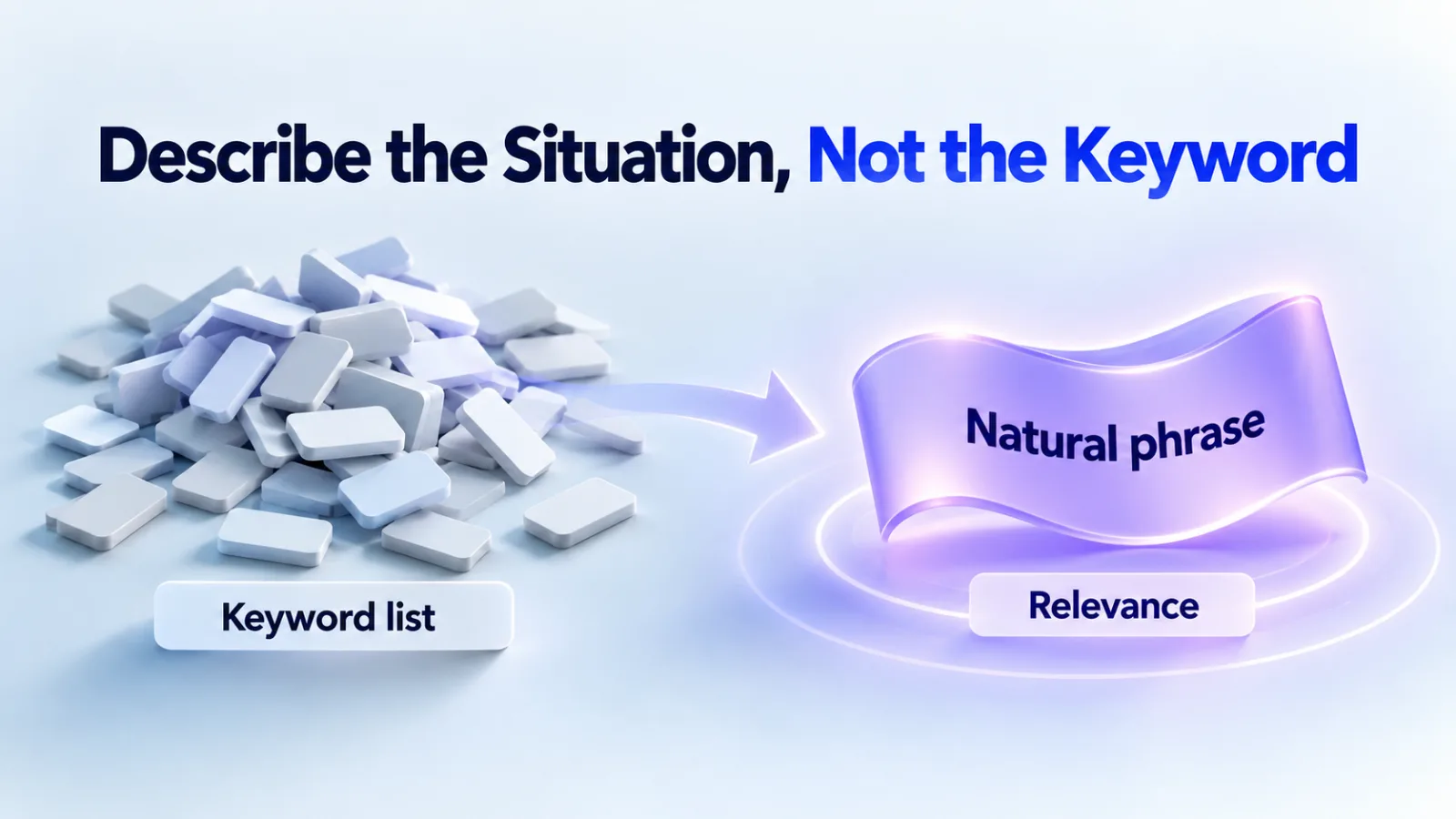
Context hints are the closest thing ChatGPT Ads has to keywords, which is exactly why they’re easy to get wrong. They aren’t keywords. They’re short descriptions, set on each ad group, that tell OpenAI’s systems what your offer is, who it helps and when it’s useful.
Checked against OpenAI’s documentation on 27 September 2026. Example hints in tables are ours and illustrative.
What context hints are, and aren’t
OpenAI describes context hints as extra details about your business, product or service that help its systems understand when your ads may be relevant. You add them to an ad group, for information that isn’t already clear from your ad or landing page.
- They inform relevance. People don’t have to use your exact words for the need you describe to match.
- They can describe which products an ad group promotes, which clarifies its scope.
- They don’t guarantee your ad appears in particular conversations or for particular audiences.
- They aren’t targeting rules. They can’t enforce locations, schedules or exclusions, so there’s no such thing as a negative hint.
OpenAI draws the line with a plumbing example: saying your plumbing service is available in Chicago describes the business, while asking for the ad to show only in Chicago is a delivery instruction. Use location targeting for that.
Where hints fit in ad matching
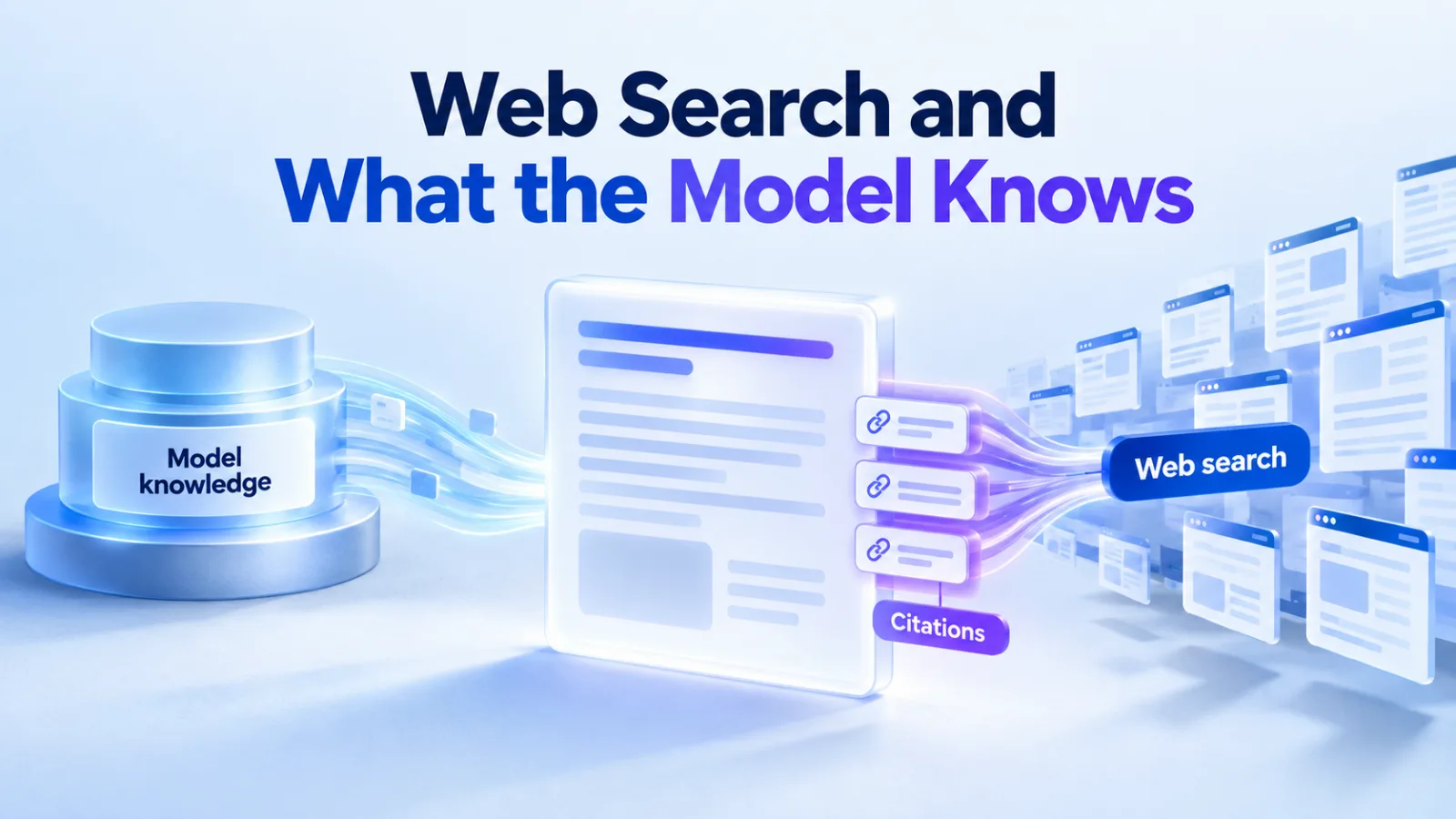
OpenAI says its ads system chooses ads on expected relevance and outcomes, using several signals: the context and intent of the current conversation; the ad’s landing page, title and copy; your context hints and targeting choices; and, when a person has ads personalization on, signals from their wider use of ChatGPT. When several ads qualify, relevance and bids decide which appears first.
So a hint is one input among several. It can’t rescue an ad whose landing page is about something else, and it doesn’t need to repeat what the page already makes obvious. In the EEA and Switzerland, where ads aren’t personalized yet, the parts you control, including hints, have fewer other signals to compete with. More on that in our availability tracker.
Write hints around what, who and when
OpenAI suggests asking what else its systems should know about your product, who it helps and when it’s useful. Each hint should be one clear, natural phrase about a single idea; it doesn’t need to cover all three angles.
| Angle | What to describe | Example |
|---|---|---|
| What | Features, services, pricing, availability or service areas that matter to buyers. | Same-day delivery of ergonomic office chairs across Greater London |
| Who | The needs, preferences or circumstances your offer suits. | Office chairs for people who sit for long hours and want adjustable lumbar support |
| When | Situations or decisions where your offer helps. | Setting up a home office after moving to remote work |
Four tests for a strong hint
OpenAI names four qualities. Run each hint past all of them.
- Additional. It adds context beyond what the ad and landing page already make clear. A detail that’s on the page can still help if the hint ties it to a need, the way “breathable” matters more once you mention training in hot weather.
- Specific. It names a concrete feature, service detail, customer need or situation.
- Relevant. There’s a genuine link between your offer and the use case. OpenAI points out that wanting to reach a group doesn’t, by itself, make your offer relevant to them.
- Accurate. It reflects what you actually sell. Update hints when features, prices, promotions, availability or service areas change.
Examples by industry
| Business | Keyword-style (weak) | Situation (stronger) |
|---|---|---|
| Furniture store | sofa, couch, sectional | Compact sofas for small apartments with narrow doors and stairs |
| Electrician | electrician near me, cheap electrician | Evening and weekend EV charger installation for homes in Leeds |
| B2B software | crm software, best crm | A CRM for agencies of 5 to 50 people that bill clients on monthly retainers |
| Online course | learn excel, excel course | Self-paced Excel training for finance teams preparing month-end reports |
| Holiday rentals | lisbon hotels, lisbon apartments | Family apartments in Lisbon with a full kitchen, for stays of a week or more |
| Pet supplies | dog food, best dog food | Monthly delivery of large-breed dog food for owners who don’t want to carry heavy bags |
Mistakes that waste hints
- Keyword lists. OpenAI asks for a natural phrase focused on one idea, not a list of disconnected keywords.
- Delivery instructions. “Only show this to people in Chicago” is a targeting rule, and hints can’t enforce it. Set locations on the campaign.
- Wishful audiences. Describing the people you’d like to reach, rather than the people your product genuinely suits, fails the relevance test.
- Stale details. A hint promising last month’s promotion is inaccurate, and inaccurate hints work against you.
- Everything in one ad group. Products that need different messages or landing pages belong in separate ad groups.
- Several ideas in one hint. Split them. Each hint should describe one situation clearly.
Organizing hints across ad groups
OpenAI recommends building each ad group around a shared product, service, theme or customer need, and splitting ad groups when use cases call for different messaging or landing pages. Its example is a plumbing business with one ad group for emergency repairs and another for preventive maintenance: the same business, two different needs.
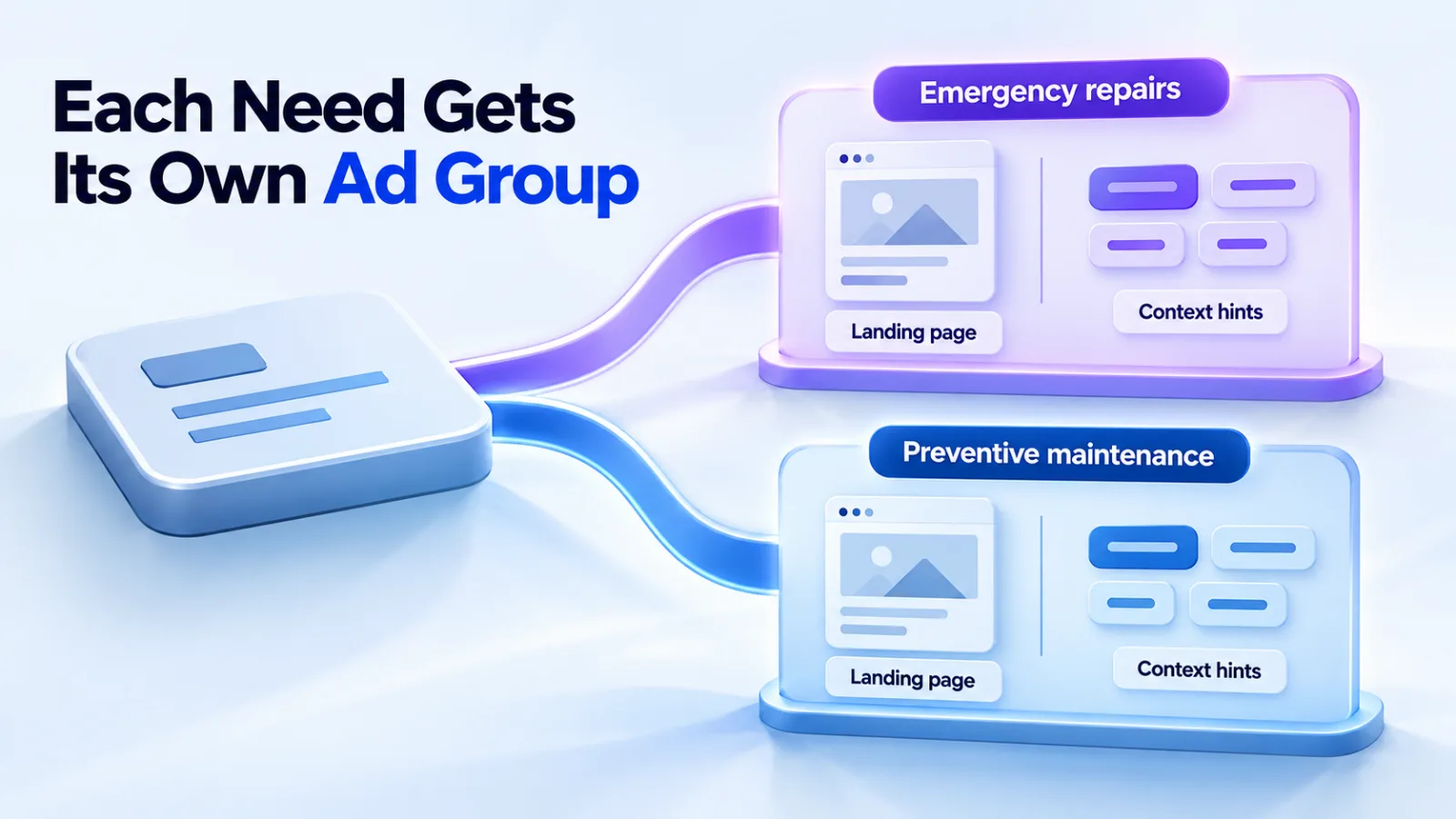
A workable rule: one ad group per need, one landing page that answers that need, several ads with distinct angles, and a handful of hints that each describe one situation where the need comes up.
How to test hints
Ads Manager reports at the campaign, ad group and ad level, and we haven’t found reporting for individual hints. So test them through ad groups:
- Put distinct needs in separate ad groups, each with its own landing page.
- Give each ad group a few hints describing its situations.
- Compare delivery, click-through rate and conversions by ad group once there’s enough data. Conversions take 24–48 hours to report.
- Rewrite the hints in weaker ad groups, one change at a time, so you can tell what made the difference.
Questions
How many hints should an ad group have?
OpenAI doesn’t give a number. Keep each hint to one idea, and keep the hints in an ad group about the same product, service or need.
Can I use hints to exclude conversations, like negative keywords?
No. OpenAI says hints can’t enforce exclusions, and it doesn’t offer negative keywords. Exclusions available elsewhere in Ads Manager, such as locations and customer lists, are set as targeting.
Can a hint target a city?
A hint can describe your service area, which helps relevance. To restrict where ads show, use location targeting on the campaign.
Do people need to use the words in my hint?
No. OpenAI says the underlying need or situation can be relevant without the exact words, which is why describing situations works better than listing terms.
Want help with hints and creative? See our context hints and ad creative service, or start with the setup guide.
Sources
- Write context hints for ChatGPT Ads, OpenAI Help Center
- Create ad groups for ChatGPT Ads, OpenAI Help Center
- Targeting, OpenAI developer docs
- Ads in ChatGPT and Measure results, OpenAI Help Center
All sources checked on 27 September 2026.